
The spark: why this animal just took over your feed
In the last few weeks, short videos of a black-and-white mustelid squaring up to cobras, raiding hives, and stealing scraps from bigger predators have exploded across Arabic, English, and French reels. The captions call it everything from “the new king of the bush” to “the animal that fears nothing.” The animal is the honey badger—also called ratel—and it’s tailor-made for the internet: compact, charismatic, and astonishingly willing to escalate.
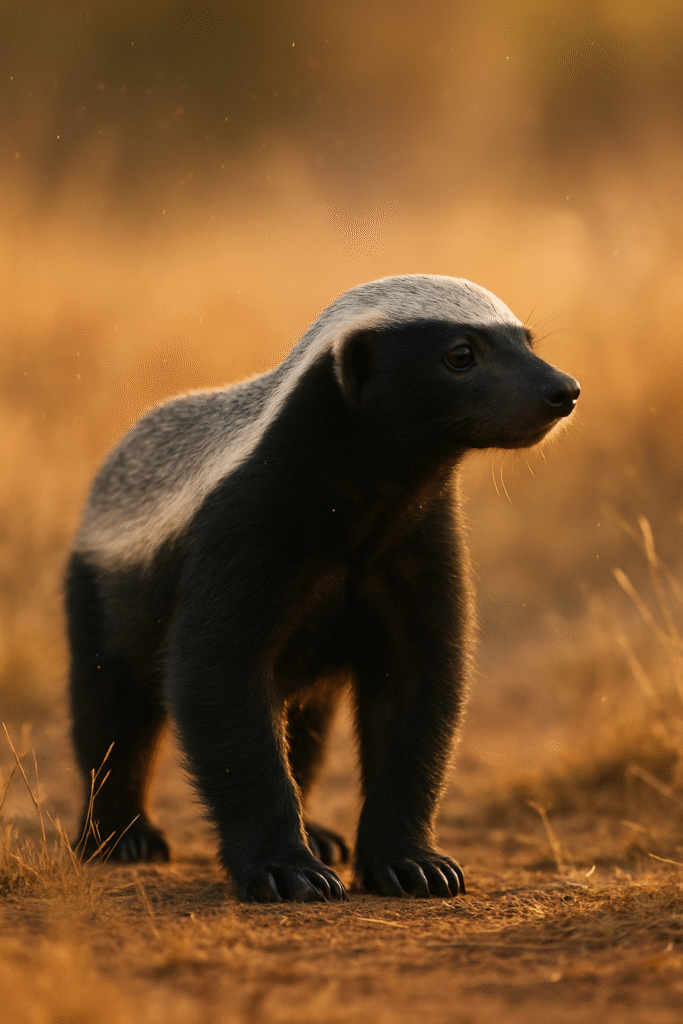
But virality often edits out context. This article gives you the full picture—the real adaptations that make honey badgers formidable, what’s hype, what’s science, and how to photograph or coexist with them without turning drama into damage.
Identity: what a honey badger is (and isn’t)
- Family: Mustelidae (the weasel clan—otters, wolverines, martens, badgers).
- Range: Much of sub-Saharan Africa, plus Arabia and parts of Iran, Pakistan, India, and western Nepal. From deserts to woodlands to farmlands, so long as there’s cover and food.
- Look: Stocky, low to the ground, with a distinct pale “cape” running from forehead to tail over a black body. Face is dark; legs are powerfully muscled; foreclaws are long, white, and shovel-sharp.
- Size: 9–16 kg typically; males larger than females.
- Diet: Classic omnivorous opportunist—rodents, reptiles (including venomous snakes), birds and eggs, insects, carrion, fruits, and, yes, honey and brood from wild hives.
- Status: Globally Least Concern, but declining in many places from persecution, snaring, and roads.
They’re not mini-wolverines and they’re not magic. They’re small, over-engineered problem-solvers that take advantage of hesitation.
The toolkit: five reasons your timeline thinks they’re fearless
1) Armor you can pinch
Honey badgers have thick, rubbery, and unusually loose skin—4–6 mm on neck and shoulders. A predator’s bite often gets only skin, letting the badger twist inside the grip and counter-bite. It’s not bulletproof; it’s wiggle-proof.
2) Claws + shoulders = excavator
Those long foreclaws and heavy forelimbs can dig a sleeping burrow in minutes, flip rocks, or rip into termite mounds and beehives. Underground speed is a superpower you rarely see on camera.
3) Stink diplomacy
Like many mustelids, honey badgers have anal scent glands. When cornered, they can spray a choking odor that buys seconds. Video rarely captures smells—but other animals do.
4) High pain tolerance + fast recovery
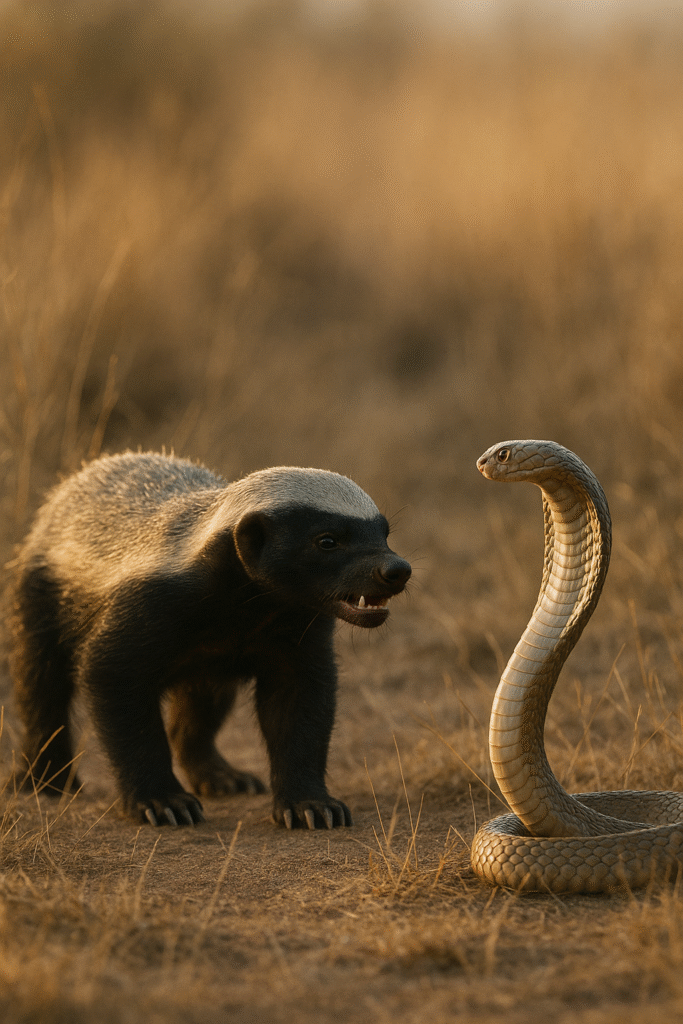
They’re not invincible, but they tolerate bee stings and can survive doses of some snake venoms that would kill other mammals of similar size. Accounts of temporary stupor after a cobra bite followed by recovery are consistent—but not guaranteed. Many badgers die from venom and wounds.
5) Nerves (and brains) of steel
Honey badgers push their luck because it often pays. They’re intelligent—capable of opening latches, climbing obstacles, even using tools (sticks or debris) to escape enclosures in documented cases. A bold, curious carnivore with problem-solving skills makes great footage.
Viral scenes, explained (and de-hyped)
- “Honey badger vs. lion.” Real clips show badgers harassing, bluff-charging, or escaping lions and hyenas. Outcome if a big cat commits? Badger loses. The internet posts the survivals, not the failures.
- “Immune to venom.” No mammal is immune to all venom. Honey badgers show tolerance and recovery in some cases, likely due to physiology and exposure—but bites can and do kill them.
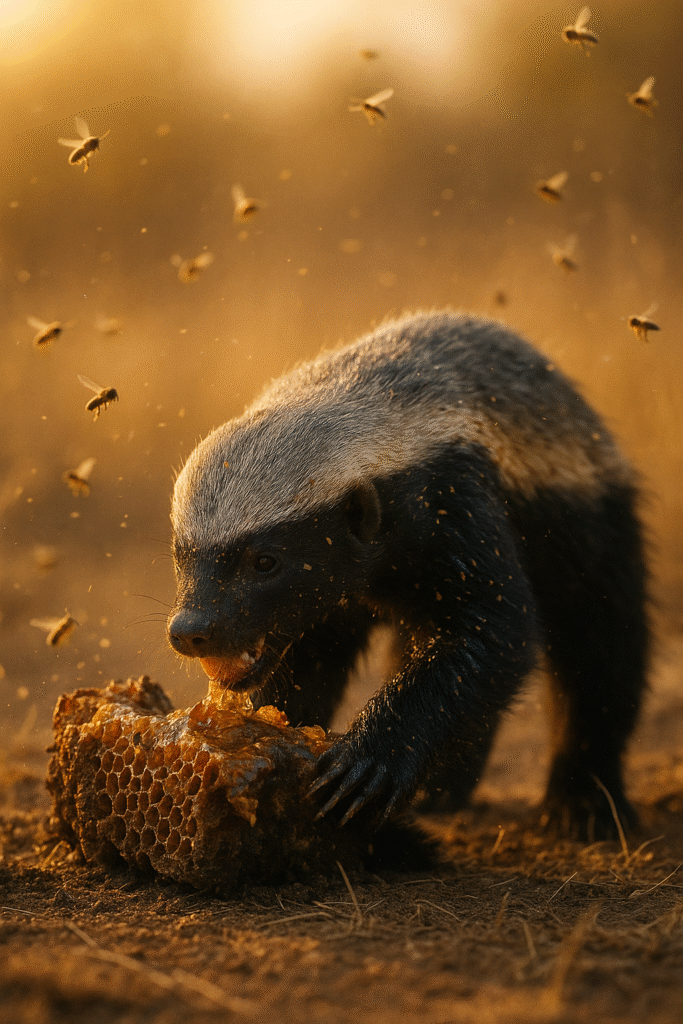
- “Always after honey.” They raid hives, but insects and small vertebrates make up much of the diet. The name sticks because bee raids are noisy and memorable.
- “Bird guides them to hives.” The famous partnership with the greater honeyguide (a bird that leads mammals to bees) is well documented with humans. With honey badgers, there are credible observations but fewer than popular stories suggest. Treat it as occasionally true, not universal.
Survival battles: the physics of a small tank
- Against snakes: Badger tries to disable the head with rapid bites and foreclaw pinning. Success depends on snake size and room to maneuver.
- Against canids and hyenas: Badger backs into a burrow or thorn cover, snarls and sprays, and targets soft parts with counter-bites. Predators often decide the energy cost isn’t worth it.
- Against bees: Thick skin and fur absorb stings; face stings still hurt. They often retreat between rushes, shake off clusters, and return.
The lesson: it’s not fearlessness—it’s math. A small animal wins by convincing bigger animals the risk-reward ratio is terrible.
What you didn’t know (and will remember)
- Solo lifestyle: Mostly solitary except for mothers with cubs; home ranges can be large for their size.
- All-weather burrowers: They commandeer aardvark or warthog holes or dig new dens nightly to avoid scent trails and fleas.
- Vocal range: Grunts, growls, and high-pitched “rattles”; cubs “ee-eee” like birds.
- Night vision, day swagger: Active day or night depending on persecution; where hunted, they go nocturnal.
- Bee armor hack: Some raid at cool hours when bees are sluggish; others roll in mud first.
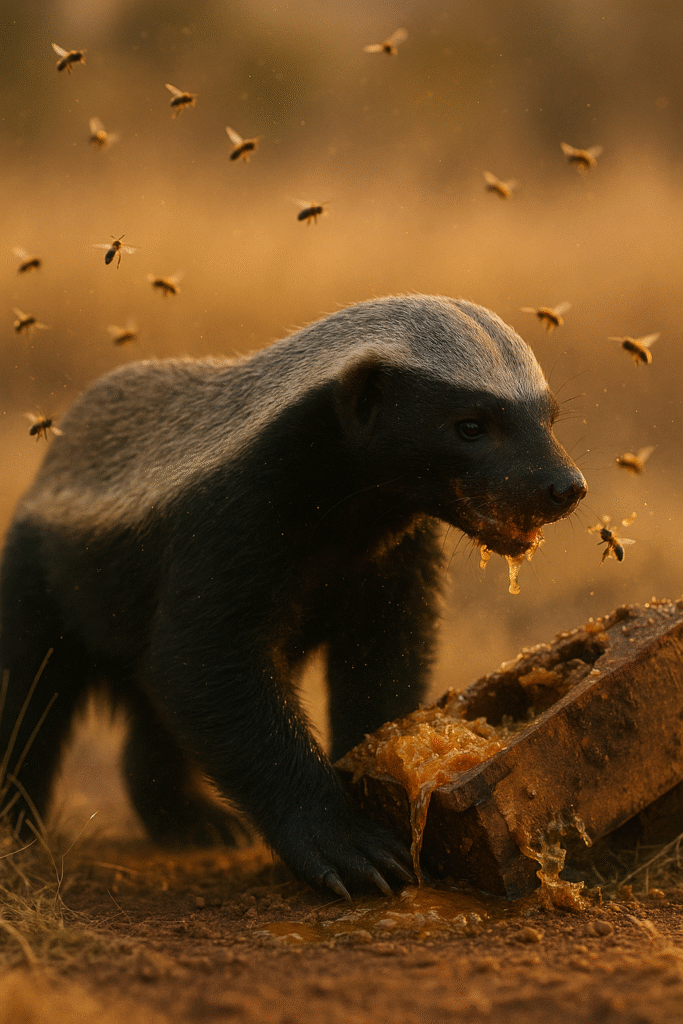
- Farm frictions: They break into chicken coops and beehives; livestock-guardian dogs and solid coop design reduce conflict.
- Road risk: Their low profile makes night collisions common on paved corridors.
- Cultural names: Arabic: غرير العسل; Afrikaans: Ratel; Hindi: बीवर/ हनी बैजर (regional names vary).
- Strength: size ratio: They can drag prey heavier than themselves and carry it into cover.
- Longevity: Wild life spans aren’t well documented; in care, well over a decade.
- Legal status: Protected in many countries; still snared or poisoned where laws aren’t enforced.
- Meme roots: The “Honey Badger Don’t Care” narration (2011) turned a desert specialist into a global icon—the current surge is a sequel, powered by short-form video.
Field guide: where to see one (and how not to ruin it)
- Best biomes: Savanna and semi-desert with rocky cover; edges of agricultural land where rodents are abundant.
- Hotspots (general): Southern Africa (Kalahari fringes, thornveld), East Africa (Acacia scrub), Arabian Peninsula wadis, western India’s dry zones.
- Signs: Diggings at termite mounds; scratched hive remains; strong musky scent near den entrances.
- Etiquette for creators:
- Keep distance; use long lenses (400–600 mm).
- No baiting with honey or dead snakes—illegal and unethical.
- If a badger huffs or tail bristles, back off; stress costs calories it can’t spare.
- Never block a badger from reaching burrow cover for a “better angle.”
Majestic photography + storytelling (pro tips)
- Angles that tell truth: Low eye-level to show stature; include environmental context (burrow mouth, hive debris, thorn scrub) so viewers learn habitat, not just attitude.
- Behavior frames: Foreclaw dig; quick head snap toward a snake; shake-off after a bee rush; mother leading a cub between rocks.
- Light: Early/late sun to model the pale cape; avoid midday shimmer that “melts” the outline.
- Alt text ideas: “Honey badger excavating a burrow with long white claws,” “Honey badger raiding a beehive at dawn, bees swarming,” “Mother honey badger leading cub across sandy wash.”
Coexistence & conflicts: practical fixes that work
- Beehive protection: Mount hives on smooth steel poles with tin baffles; use electric fencing powered by small solar units—cheap, effective, and reduces retaliation.
- Poultry security: Close gapless night coops with buried wire skirts (30–40 cm) so badgers can’t dig under; lock feed to avoid attracting rodents (which attract badgers).
- Roads: Reflective “wildlife eyes” and speed-calming signage at known crossings; clear roadside carrion quickly.
- Guardian dogs: Properly managed LGDs deter nighttime raids without killing wildlife.
- Snare removal: Community patrols that sweep snare lines prevent bycatch of all small carnivores.
- Compensation/rapid repair funds: Small grants to fix damaged hives or coops cut revenge killings dramatically.
Symbolism, culture, mythology
Across the Sahel and Arabia, storytellers cast the honey badger as the audacious neighbor—stubborn, clever, a little rude, and weirdly admirable. In internet culture it became the avatar of relentlessness. As a brand for conservation, that mix is gold: you can laugh at the bravado and still learn the boring, effective measures that let people and badgers share a landscape.
Personal narrative + moral
On a dusty track at blue hour, a shape crossed like a moving helmet with legs. It stopped, sniffed the air, and gave us a look that read: “Are you an obstacle or a concept?” Then it trotted into a patch of thorn and was gone. The clips make the honey badger look immortal; the truth is better—it’s adaptable. Give it cover, rodent-rich fields, and farmers who protect hives instead of setting poison, and the legend stays local and alive, not just viral.
Moral: Enjoy the swagger, but respect the species. Viral fame should buy practical coexistence—stronger coops, protected hives, snare-free zones—not dramatized confrontations.
Fast FAQ
Is the honey badger dangerous to people?
They avoid humans when given space. Cornered or handled, they defend fiercely. Keep distance and there is no issue.
Do they really eat cobras?
They can and do eat venomous snakes, but it’s risky and not daily fare. They take safer prey whenever available.
Why are they trending now?
Short clips amplify bold behaviors. A few viral reels in Arabic and English triggered the algorithmic wave.
Are they protected?
In many countries yes, but enforcement varies. Persecution around hives and chicken runs remains a problem.
How can I help?
Promote hive and coop protection instead of killing wildlife; support snare-removal teams and road-kill mitigation; share accurate info, not staged fights.
Reply