
Rare moment — a breath like a comma on a flat sea
Vaquita porpoise conservation is critical – this article explores how and why. However, Dawn pressed a copper line across the Upper Gulf of California. The water looked ironed, sea birds tired, engines cut. We floWe floated in the hush until a small oval of air trembled the surface. It was a brief, shy exhale, soft as someone turning a page. exhale, soft as someone turning a page. A gray back rose, a tiny curved fin—then nothing. Vaquita. Ten seconds of existence in a place wide enough to forget anything. Meanwhile, another breath answered. The sea went quiet again, but the silence felt inhabited.
Furthermore, we will delve into the identity, biology, and survival challenges of this species.
For example,
The vaquita is not a myth. It is a pocket-sized porpoise—a living edge-case—and the most endangered marine mammal on Earth. Its story is a map of mistakes we can still fix.
Identity: who the vaquita is (and isn’t)
- Species: Phocoena sinus, a true porpoise (not a dolphin).
- Look: Small (about 1.4–1.5 m), compact, with a tall triangular dorsal fin, dark “lipstick” around the mouth, and panda-like eye patches.
- Range: Endemic to a single place—the Upper Gulf of California (Mexico). A home range so small you can draw it on a placemat.
- Diet: Bottom and midwater fishes, small squid, and shrimp—taken in short, quiet foraging bouts over shallow, turbid flats.
- Voice: High-frequency echolocation clicks above the hearing of most predators (and us). Vaquitas are naturally quiet around boats, which makes them hard to detect—until you listen correctly.
- Temperament: Boat-shy, surface briefly, no acrobatics. If you see a splash, it wasn’t a vaquita.
This is not a wandering whale. It is a neighborhood animal—faithful to a shelf of green water and dust-colored sky.
Additionally, these biological traits are finely tuned to the Upper Gulf’s murky waters.
Strange/remarkable: biology built for a brown sea
- Firstly, big fin, small body. The tall dorsal fin bleeds heat in scorching, windless summers; it also stabilizes tight turns in choppy tide.
- Secondly, eyes with makeup. Dark patches reduce glare in shallow, sunstruck water; they also make calves’ faces easy for moms to “read.”
- Thirdly, quiet clicks, close talk. Vaquitas echolocate at very high frequencies, which carry poorly in air—great for stealth, poor for long-range chat.
- Lastly, turbidity advantage. In mud-clouded water, vision hunters falter. An echolocating porpoise wins—until a net says otherwise.
Survival battle: a perfect mammal versus a perfect trap
However, this section explains the human-made threats and how gillnets become lethal.
The vaquita’s main threat is brutally simple: gillnets—near-invisible curtains of monofilament stretched for fish and, especially, for an endangered croaker called totoaba. Porpoises hunt, echo a fish, sprint, and hit the mesh headfirst; fine twine wraps the jawline and flippers. A minute of panic, a lungful of water, a silent body. Bycatch is not a “conflict with fishermen.” It’s a physics mismatch between breathing air and catching fish with walls.
Remove gillnets, and vaquitas do not need a miracle. They already breed, feed, and raise calves in the same water—if we let them.
What you didn’t know (and won’t forget)
Finally, we’ll share surprising facts that reveal hope for this species.
- Smallest of all cetaceans. A full-grown vaquita is shorter than many people are tall.
- Homebodies by design. They live year-round in one shallow gulf—no thousand-mile migrations to track or protect.
- Calves ride the slipstream. Newborns draft beside mom’s flank; good seas let them surface in perfect sync.
- They avoid boats on purpose. Centuries of quiet living make them naturally wary; the best surveys now “hear” them instead.
- Acoustic listening works. Hydrophones can log click trains and track hotspots without chasing animals.
- They still have calves. Sightings of small fins show recruitment continues where nets are absent.
- Fishing doesn’t have to kill them. Vaquita-safe gear (hook-and-line, traps, modified trawls) can catch target species without curtains of death.
- Totoaba trade is the driver. High-value swim bladders create a black market; when that pressure falls, bycatch crashes.
- Enforcement is logistics. Night-vision drones, coordinated patrols, and net buy-backs beat press conferences.
- A dozen can recover. Small cetaceans can rebound fast when adult female survival rises; biology is not the barrier—policy is.
Rare moment (rescue): the net with no end and the knife with no noise
The panga had no lights. Rangers saw the floats by starlight and slipped in silently. No arguing on the water—cut, coil, bag. A few minutes later, another curtain of mono; then another. At dawn they found the last one by a gull sitting heavy, the way gulls sit when something is hung just below. The crew lifted a limp porpoise calf, eyes still open, and there was a moment no one spoke. The next night there were three fewer nets, then five. That is what rescue looks like for vaquita: emptier water, not photos with towels.
Field guide (for readers, photographers, and tour operators)
- Where (general): Northernmost Gulf of California—turbid shallows near the Colorado River delta.
- When: Glassy early mornings with weak wind; spring–early summer for the best sea state.
- How (ethically): Observe from slow, distant boats; never pursue. If the sea “dents” gently twice and goes blank, you were lucky.
- Photography: Long lenses from a steady platform; expect one frame per surfacing, if any. The story image might be the flat sea with a caption about absence—and that’s OK.
- Do not: Share precise pins, follow small groups, or crowd any enforcement operations.
Threats: the modern ledger
- Illegal gillnets (totoaba and other target species) → bycatch and drowning.
- Market demand for totoaba swim bladders → organized poaching.
- Weak or inconsistent enforcement → nets return after sweeps.
- Gear substitution gaps → fishers lack viable alternatives and income bridges.
- Habitat stress (delta alteration, noise) → secondary but rising pressures.
What works (field-tested, practical)
- Permanent gillnet bans in the core range—no exceptions, with real patrol coverage at night.
- Net buy-backs + boat refits that swap to vaquita-safe gear (traps, hook-and-line, small trawls with observers) and guarantee markets.
- Target the market, not just the net. Cross-border enforcement against totoaba trafficking—dry the demand, not just the nets.
- Acoustic monitoring grid to locate hotspots and focus patrols; publish indices, not pins.
- Co-op fisheries: payboats that meet bycatch rules get premium pricing and fuel vouchers; violations lose privileges fast.
- Ghost-net retrieval: weekly sweeps with grapples and sonar; logs burned or shredded onshore, not “stored” to drift again.
- Community guardians: fishers on salary for patrols; pride programs that make vaquita-safe a badge, not a burden.
Majestic photography + storytelling (how to make absence visible)
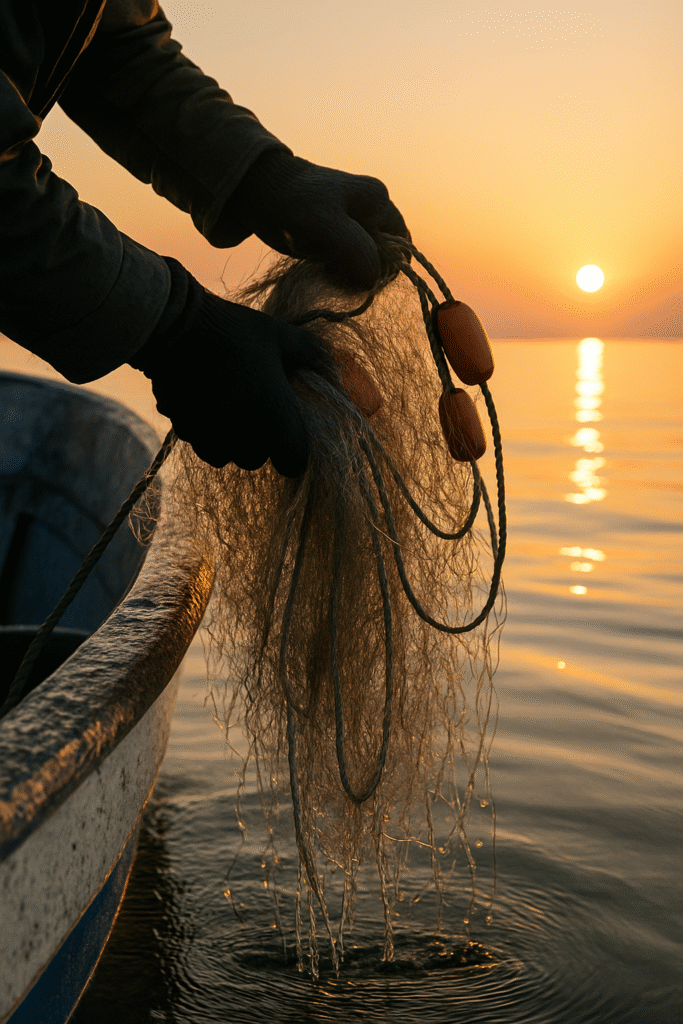
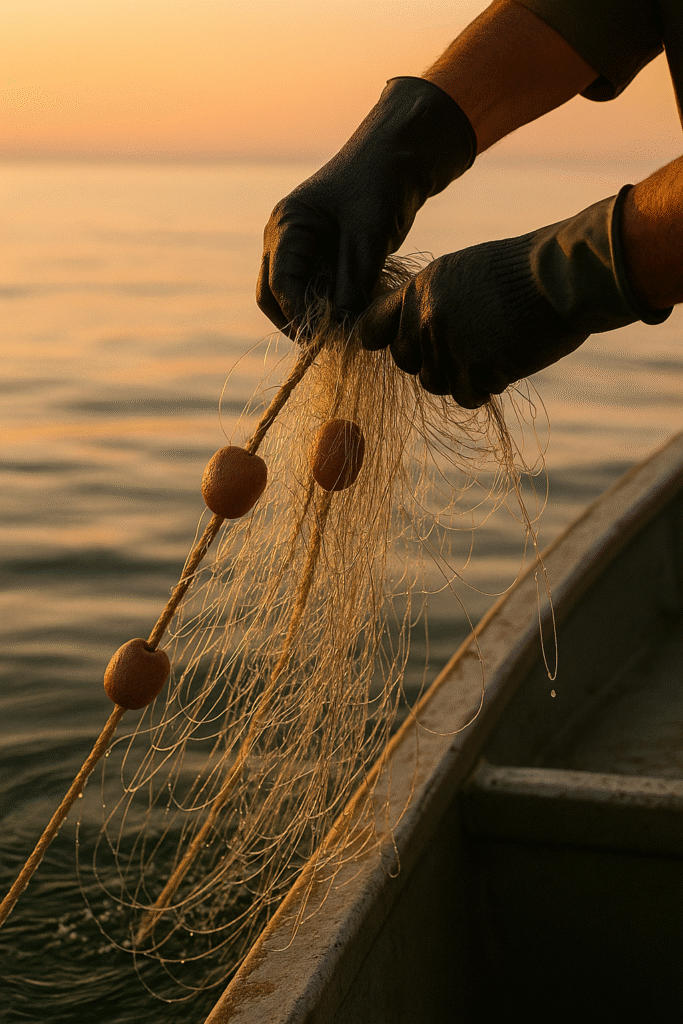
- Image set: (1) mirror-calm sea with a single ripple; (2) hands hauling a ghost net into a panga; (3) hydrophone string over the gunwale at sunrise.
- Captions: “Sound survey logging vaquita clicks”; “Net buy-back day—nylon to ash”; “Two breaths, ten seconds apart.”
- Tone: Respectful, unsensational. The hero is water without nets.
Symbolism, culture, mythology
Locals call it vaquita marina—the little cow of the sea. In a region where fishing is identity, not just income, the animal has become a mirror: proof that a community can change how it fishes without losing who it is. As a symbol, vaquita is not a celebrity; it’s a neighbor whose porch light is a tiny fin at dawn.
Climate realism: hot years, louder lessons
Marine heat waves push prey deeper or away, making vaquitas work harder for food. That makes zero bycatch non-negotiable—there is no energy margin for extra hazards. Wind farms, shipping lanes, and coastal growth must plan with quiet corridors where clicks, not props, own the soundscape.
Personal narrative + moral
However, we waited another hour for a second look that never came. Still, the Gulf stayed flat. Onshore, a pile of monofilament smoldered in a barrel, shrinking by the inch. It did not feel like triumph. Instead, it felt like maintenance — the adult kind that turns small lives into future years. The moral is blunt: biology has not failed the vaquita; we have. Replace gillnets with livelihoods. Make enforcement boringly reliable. Then the smallest whale will keep writing commas on calm water.
Fast FAQ
Firstly, it’s a porpoise—a small toothed whale, closer to harbor porpoises than to dolphins.
Secondly, very few—critically few—remain. But calves are still seen, which means recovery is possible if bycatch stops.
Thirdly, past attempts showed high stress in captivity; the species is best saved in place by removing nets.
Moreover, fishing can continue with vaquita-safe gear and verified supply chains that reward compliance.
Finally, readers can support groups funding net removal, enforcement, and gear transition, and share accurate stories that put solutions—not despair—front and center.
Closing
A vaquita’s breath lasts about as long as a sentence. Keep the water honest—no nets, quiet lanes, fair jobs. Then those sentences keep appearing, shy and perfect, on mornings when the Gulf looks like polished glass.
Additionally, change is possible. Furthermore, communities can adapt. Consequently, species can recover.
Hence, we need action. In contrast, doing nothing ensures extinction. Moreover, policymakers must commit. Similarly, local communities must benefit. Consequently, the vaquita can thrive. Meanwhile, global attention grows. Therefore, every action counts.
Ultimately, survival is in our hands.
First, the vaquita is a small porpoise. Next, it lives in a warm, brown sea. Then, people use nets to catch fish. However, the nets trap and kill vaquitas. Therefore, to save the vaquita, we must stop using these nets. Moreover, we need to help local fishers use safe gear. Finally, we must act now.
Additionally, help now.
Additionally, act now. Furthermore, help fishers. Moreover, save vaquita. Also, love nature. Next, stop nets. Then, care more. Meanwhile, speak up. Afterwards, join groups. Besides, share truth. Finally, stay hopeful.
First, go. Second, see. Third, help. Fourth, save. Fifth, act. Sixth, care. Seventh, speak. Eighth, share. Ninth, love. Tenth, hope. Then, go again. Next, see again. Also, help again. Furthermore, save again. Moreover, act again. Besides, care again. Meanwhile, speak again. Afterwards, share again. Subsequently, love again. Finally, hope again.

Reply