
A First Encounter with the Unbelievable
Imagine sailing across a calm sea when, suddenly, a massive, flat, disk-shaped creature drifts past the boat, lazily flapping fins like wings. Its body looks incomplete, as though evolution forgot to finish sculpting it. Fishermen describe it as a “swimming head.” Divers compare it to a living moon. Scientists call it Mola mola—the ocean sunfish.
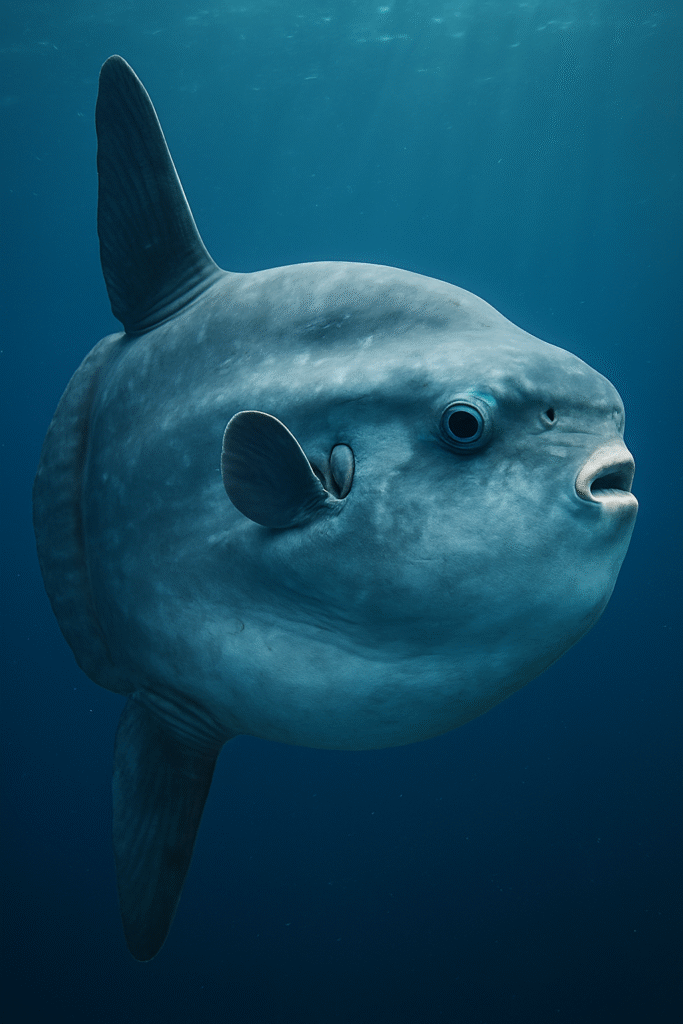
At up to 3 meters (10 feet) long and weighing over 2,000 kilograms (4,400 lbs), it is the heaviest bony fish in the world. Yet despite its bulk, the mola drifts through the water with a slow, almost comical grace, as if mocking the streamlined elegance of sharks or tuna.
The sunfish is both a marvel and a mystery—a creature that seems to blur the line between awkwardness and survival genius.
A Body Designed by Oddity
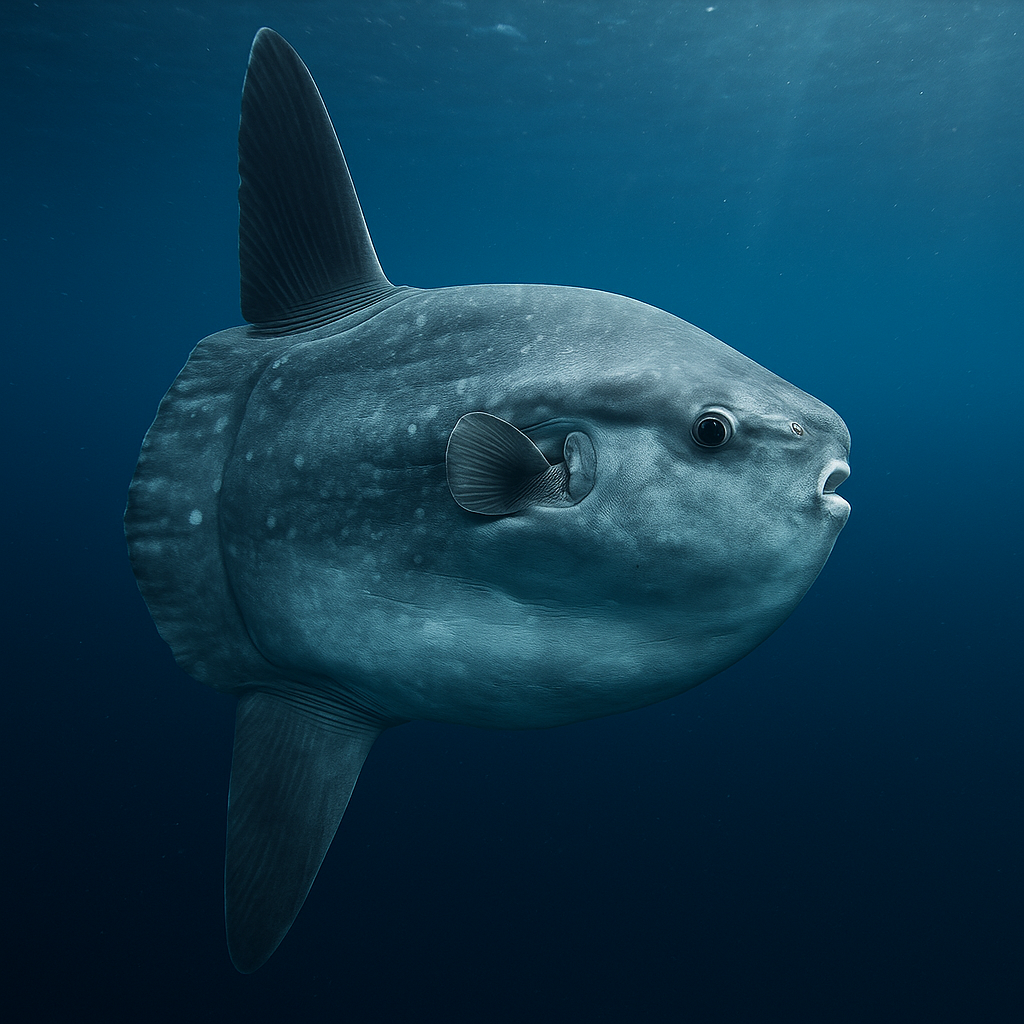
The mola’s shape defies expectations. Instead of a tapering tail, its body ends abruptly in a rounded structure called a clavus, resembling a rudder. Its dorsal and anal fins are enormous, used to propel it in an unusual “sculling” motion, unlike most fish.
Other peculiarities:
- Tiny Mouth: Permanently fixed in a beak-like grin, filled with fused teeth.
- Skin: As thick as a rhinoceros hide, covered in parasites, often hosting cleaner fish or seabirds.
- Brain-to-Body Ratio: Surprisingly small—its brain weighs less than a walnut, a fact that fuels myths of clumsiness.
But don’t be fooled: behind its odd design lies an evolutionary survivor adapted for the open ocean.
Life in the Blue Desert
Molas live in the pelagic zone—the vast, deep blue desert of the ocean where there are no reefs or rocks to hide. To survive here, they rely on:
- Diet: Mainly jellyfish, but also squid, crustaceans, and algae. Though jellyfish are low in calories, the mola compensates by eating them in enormous quantities.
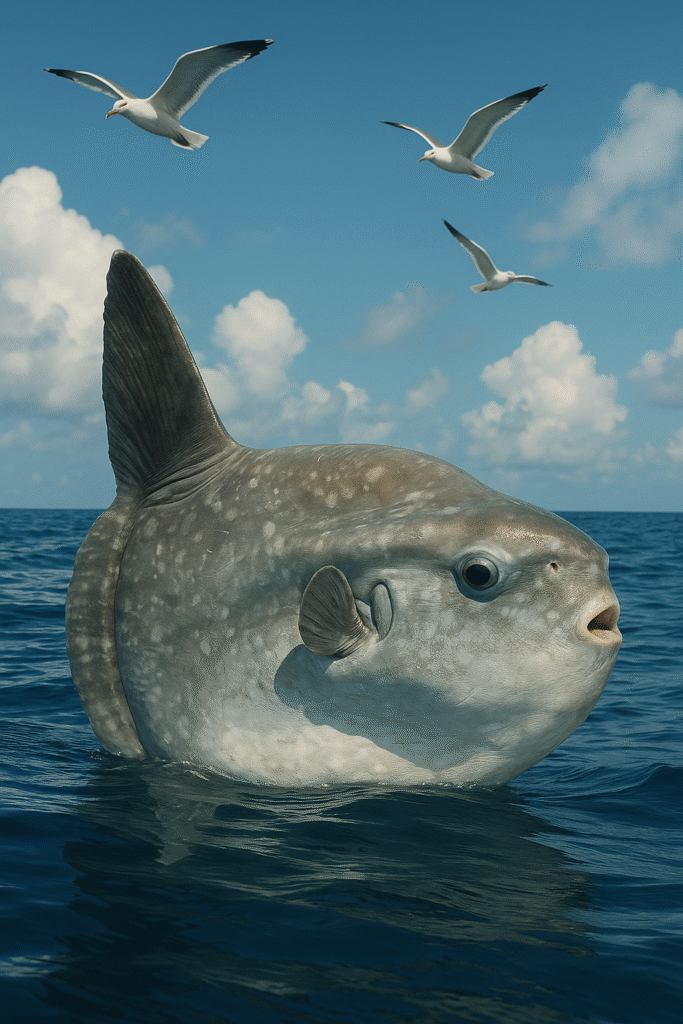
- Behavior: They often bask at the surface, lying sideways, as if sunbathing—hence the name “sunfish.” This is not for pleasure but to reheat their bodies after long dives into cold, deep waters.
- Range: Found in temperate and tropical oceans worldwide, from California to Japan to the Mediterranean.
This constant vertical migration—diving deep, then basking shallow—is part of what makes them such a spectacle for sailors and divers alike.
The Reproductive Marvel
If awkward in appearance, the mola is extraordinary in reproduction. A single female can produce up to 300 million eggs in one spawning event—the highest number recorded in the animal kingdom. These eggs hatch into tiny, spiky larvae that look nothing like their parents, resembling miniature pufferfish (their evolutionary cousins). Only a handful survive to adulthood, but those that do become giants of the sea.
Predators and Perils
Despite their size, molas are vulnerable:
- Predators: Sea lions, killer whales, and sharks occasionally prey on them.
- Parasites: Dozens of parasite species infest their skin and gills. To cope, molas seek cleaning stations or even leap out of the water to shake them off—a spectacular sight for those lucky enough to witness it.
- Human Threats: Entanglement in fishing nets, ocean plastic mistaken for jellyfish, and boat strikes are serious dangers.
Today, the mola is listed as Vulnerable on the IUCN Red List.
Cultural Symbolism
In Japan, molas are called “manbo” and are symbols of endurance and patience. In ancient mariner folklore, they were omens—sometimes of good luck, sometimes of strangeness to come. Their habit of surfacing near boats made them visible yet mysterious, and their awkward form inspired both reverence and ridicule.
In modern times, divers often describe their encounters as surreal and humbling. To float eye-to-eye with a mola is to meet an ancient, otherworldly presence—one that seems as much celestial as marine.
A Gentle Giant with a Warning
The mola is harmless, eating jellyfish instead of fish, yet its story is deeply connected to human activity. Their reliance on jellyfish ties their fate to the health of the oceans. As plastic waste fills the seas, molas risk ingesting deadly trash. Their drifting elegance becomes a mirror reflecting our responsibility: will we let the giants of the open sea continue to glide through future waters, or will they become relics of memory?
The mola teaches us that beauty is not always sleek or obvious. Sometimes, it is awkward, patient, and profound.
The Lesson of the Mola
The sunfish is an ambassador of humility in nature. It reminds us that survival does not demand perfection, only adaptation. In its enormous body, silent drifts, and whimsical basking, we glimpse a philosophy: even in vast, hostile seas, life finds a way to persist, not through dominance, but through resilience.
The mola is not a mistake of evolution—it is one of its masterpieces.

Reply