
The mountains of Central Asia guard their secrets fiercely. Their ridges and valleys are landscapes of silence, broken only by the whisper of wind and the distant cry of a bird of prey. Among these jagged cliffs—where avalanches fall without warning, where the stone itself seems alive with shadows—dwells one of the most extraordinary mammals of Earth: the Markhor (Capra falconeri).
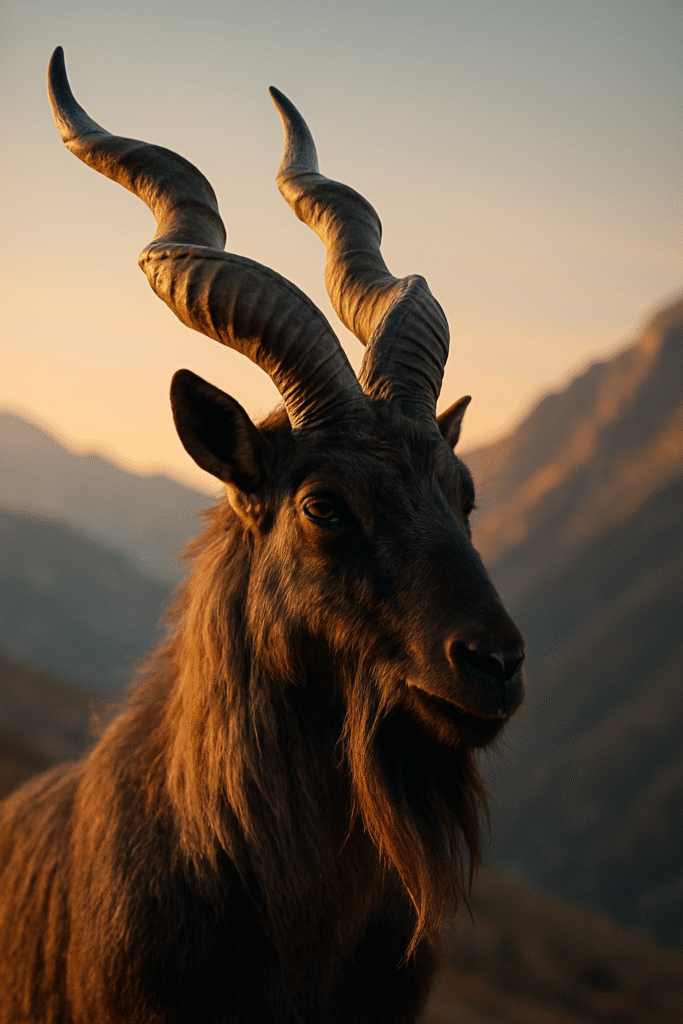
To lay eyes on a Markhor is to see living sculpture. Its corkscrew horns twist skyward as if spun by the fingers of gods, each spiral a testament to both survival and majesty. For centuries, poets, hunters, and herders alike have looked upon this wild goat not simply as an animal, but as a symbol of resilience, mystery, and power.
The Anatomy of Elegance and Power
Markhor are large goats, standing between 65 and 115 cm (2 to 3.5 feet) at the shoulder, with males weighing up to 240 pounds. Their most distinctive feature—the horns—are breathtaking in scale. Rising more than 1.5 meters (5 feet) in length, they spiral in tight coils, catching sunlight like polished ivory. Each horn is unique, with its own rhythm of turns, like a fingerprint of survival.
Their coats shift with the seasons: in winter, thick shaggy fur tumbles down from the neck and chest, like the cloak of a mountain king; in summer, it thins into sleek, short hair that blends with the rocks. Males grow long beards, adding to their regal silhouette, while females, smaller and lighter, wear more modest coats and shorter horns.
The Warrior’s Ritual – Battles in the Heights
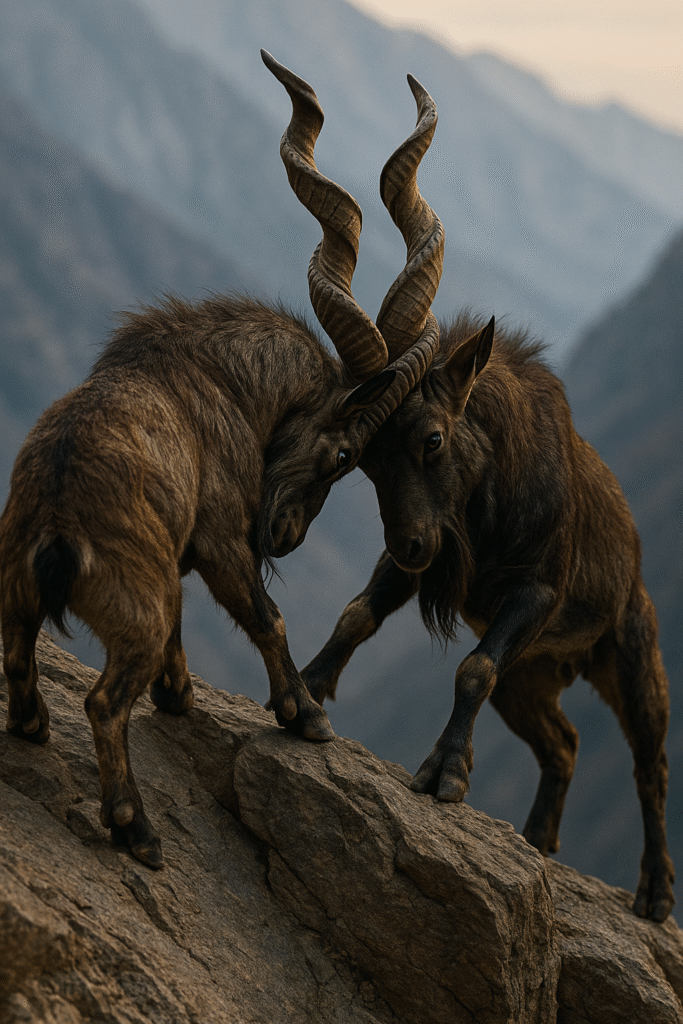
In autumn, the high mountains echo with the sound of combat. Male Markhor rear up on their hind legs—sometimes standing taller than a man—and crash down upon rivals with the thunder of horn against horn. These rutting battles are not only displays of brute strength but also endurance; fights can last for hours, with spiraled horns locked like ancient weapons.
The victor claims the right to mate, passing on the genetic memory of survival to the next generation. This ritual, repeated over centuries, has sculpted the Markhor into the muscular, sure-footed climber that dominates its perilous terrain.
Life on the Edge – A Mountaineer’s World
Markhor inhabit some of the harshest terrains known to mammals: the cliffs of the Himalayas, the Hindu Kush, and the Karakoram. These landscapes are a chessboard of danger—steep precipices, loose rock, and predators lurking in shadow. Yet here, the Markhor thrives.
Their split hooves, rimmed with gripping pads, allow them to climb almost vertical rock faces. Wolves, leopards, and even the elusive snow leopard hunt them, but the Markhor’s agility and height advantage often mean escape. A sudden leap, a sure landing, and the predator is left staring at empty rock.
They are herbivores, feeding on grasses, shrubs, and leaves, even rearing up on hind legs to strip foliage from trees. By grazing selectively, they help shape alpine vegetation, serving as ecosystem engineers in their own right.
Whispers of Myth and Legend
The Markhor is not only an animal of flesh and bone—it is a creature of story. Its very name, Markhor, translates to “snake eater” in Persian, perhaps inspired by the corkscrew horns that resemble coiled serpents. Folklore claims that the Markhor has mystical powers: its saliva, dripping on rocks, was said to kill snakes and neutralize venom, making it both feared and revered by herders.
In Afghanistan and Pakistan, the Markhor is a symbol of pride and identity. In 2015, Pakistan declared it the national animal, elevating it as an emblem of resilience. Hunters once pursued it for its horns, carving them into dagger handles believed to carry protective powers. Today, those same horns are a rallying cry for conservationists who argue that the Markhor’s survival is tied to the cultural memory of the mountains themselves.
On the Brink – A Tale of Survival
By the mid-20th century, the Markhor teetered at the edge of extinction. Trophy hunting, poaching, and habitat loss drove numbers down to fewer than 2,500 individuals worldwide. In some valleys, it vanished entirely.
Yet, against the odds, the Markhor began to climb back. Conservation programs, including community-based trophy hunting initiatives, flipped the equation. Local people were given economic incentives to protect the Markhor, turning poachers into guardians. With revenues from licensed, sustainable hunts directed into village development and conservation, populations slowly rebounded.
Today, the Markhor is listed as Near Threatened by the IUCN, with perhaps 6,000–7,000 individuals spread across Afghanistan, Pakistan, northern India, and parts of Tajikistan. Its survival is still fragile, threatened by deforestation, livestock competition, and political instability in its range. But it endures—an emblem of how human stewardship can heal what human greed once broke.
The Spiritual Spiral – Symbolism of the Horns
The Markhor’s horns are more than weapons; they are metaphors. Spiraling upward, they symbolize ascension—growth despite resistance, life twisting skyward against gravity. To Sufi poets, they represented spiritual striving. To herders, they were proof of nature’s artistry.
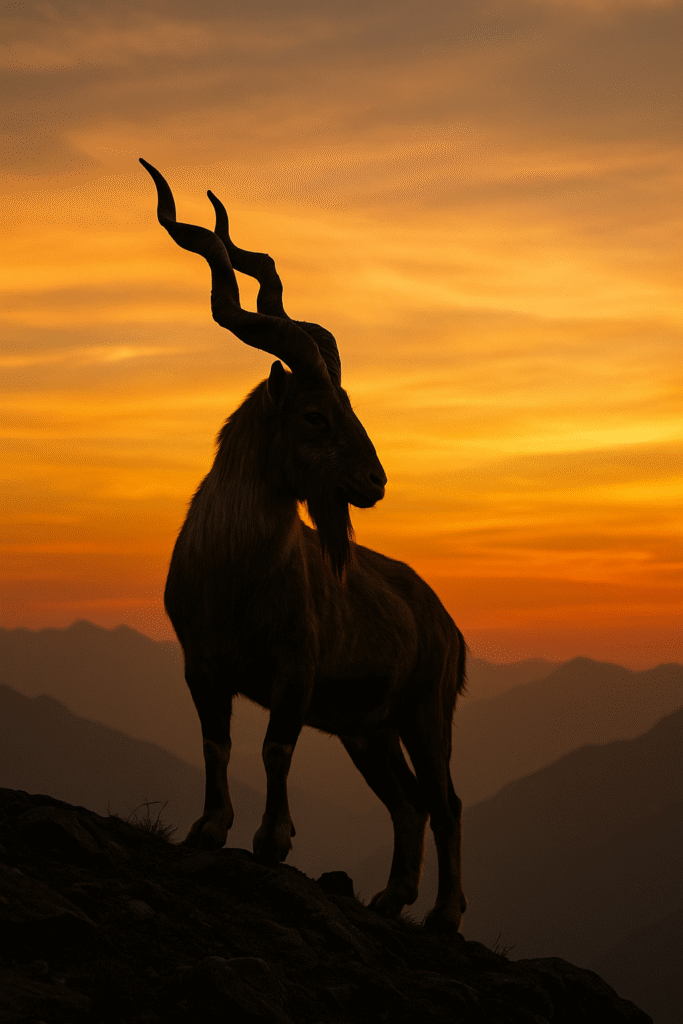
In the Markhor’s gaze lies a message: wildness does not surrender easily. Each spiral of horn is a record of years survived—winters endured, battles fought, predators evaded. In them, we see resilience etched in bone.
Why the Markhor Matters
The Markhor is not simply a goat with strange horns. It is an ecosystem architect, shaping vegetation and feeding predators. It is a cultural touchstone, inspiring legends across centuries. It is a conservation story, showing that decline is not destiny when communities rally to protect the wild.
Above all, the Markhor reminds us that beauty can endure even in the harshest of worlds. On cliffs where snow leopards prowl and avalanches roar, it stands—horns to the heavens, hooves on the edge, a survivor carved from stone and story.

Reply