
In the quiet margins of ponds, leaf litter, and sandy paths, a small brown ground beetle carries a secret worthy of a myth. The bombardier beetle (subfamily Brachininae, family Carabidae) looks ordinary—until it doesn’t. When seized by a frog’s tongue, ambushed by an ant column, or lifted between curious human fingers, it answers with heat and thunder: a staccato series of pops and a boiling, noxious spray that it can aim like a tiny turret. The spray is hot enough to scald, sudden enough to startle, and precise enough to find the softest part of an attacker’s anatomy. If survival were theater, this would be pyrotechnics.
A Two-Tank Chemistry Lab in a Beetle’s Abdomen
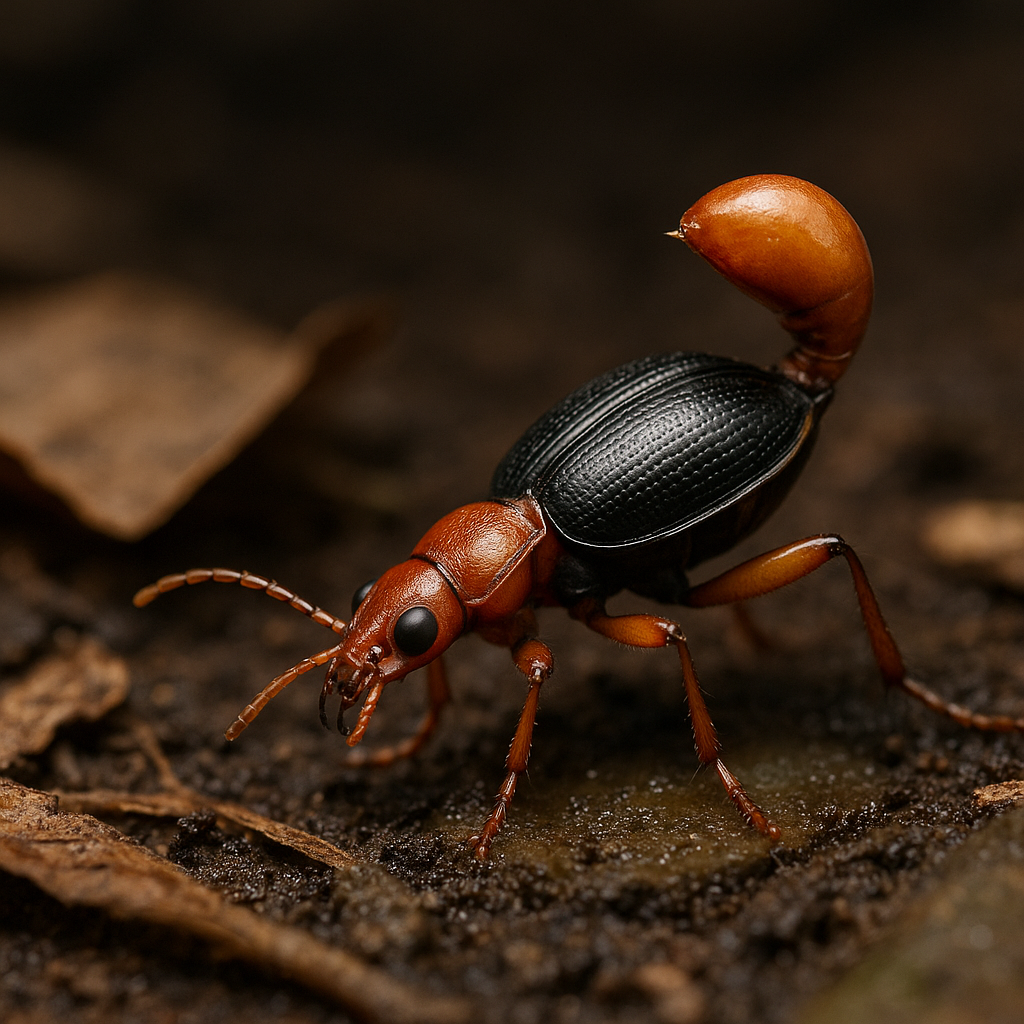
The beetle’s weapon is a masterpiece of separation and timing. Inside its abdomen sit two storage reservoirs, each harmless on its own. One holds hydroquinones, the other hydrogen peroxide. Neither chemical is mixed until the moment of crisis. When threatened, the beetle opens a sclerotized valve and meters tiny aliquots into a reaction chamber armored with heat-resistant cuticle. There, enzymes—notably catalases and peroxidases—spark an exothermic oxidation that converts hydroquinones into quinones. Heat surges. Water and oxygen gas form rapidly. Pressure climbs.
The chamber vents through a narrow outlet near the tip of the abdomen, and the beetle uses muscles in its pygidial region to pivot this nozzle through a wide arc. In many species, it can aim nearly 360°, hitting attackers clamped on its legs or flanks. The “bang” you can hear is not theatrical—it’s the pressure release of a small-scale chemical reactor.
Pulse Fire: Why the Spray Comes in Bursts
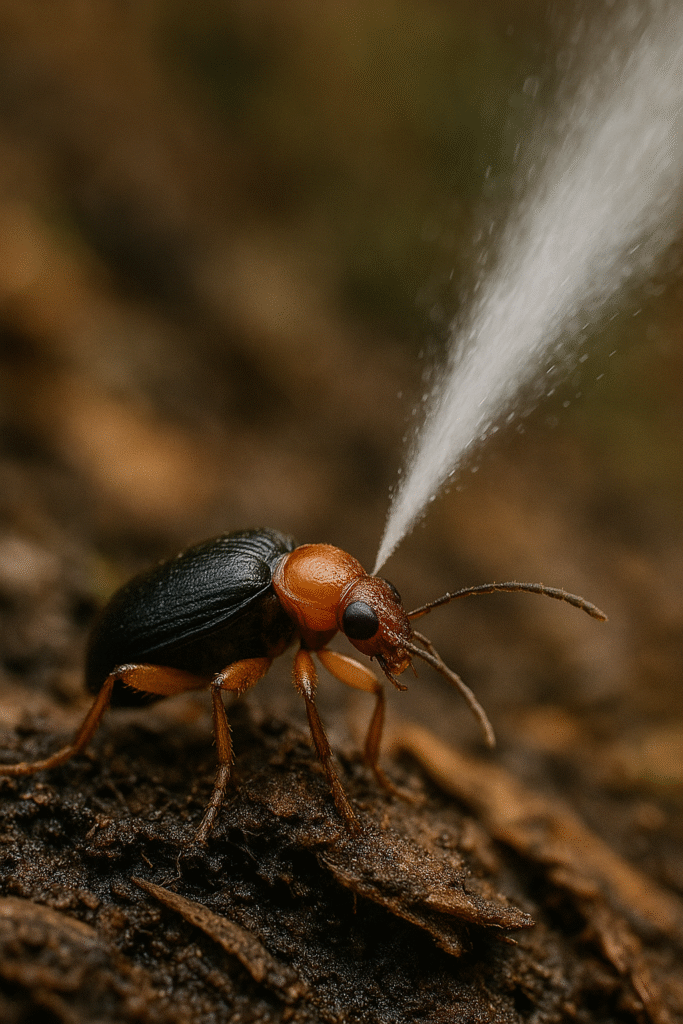
The spray rarely emerges as a single stream. Instead, it arrives as a high-frequency pulse train—dozens of miniature detonations per second. Each pulse follows the same cycle: a micro-dose of reactants enters, the enzymatic reaction rapidly heats and gasifies the mix, pressure forces the valve shut, the chamber vents and cools, the valve reopens, and the cycle repeats. The result is an audible “tat-tat-tat” and a fog of boiling droplets that cling to sensitive tissues like eyes, mouthparts, or a frog’s palate. Pulsing keeps chamber temperatures controlled, prevents structural damage to the beetle, and maximizes deterrence while minimizing the volume expended.
Heat, Chemistry, and Sensory Overload
The cocktail the beetle ejects does three things at once:
- Thermal shock: Temperatures near the outlet can reach the boiling point of water, delivering an instant burn on contact.
- Chemical irritation: Quinones and other oxidized products are irritating and sticky, compromising membranes and sensory surfaces.
- Startle effect: The audible crackle pairs with the unexpected heat to trigger withdrawal and learning—attackers remember.
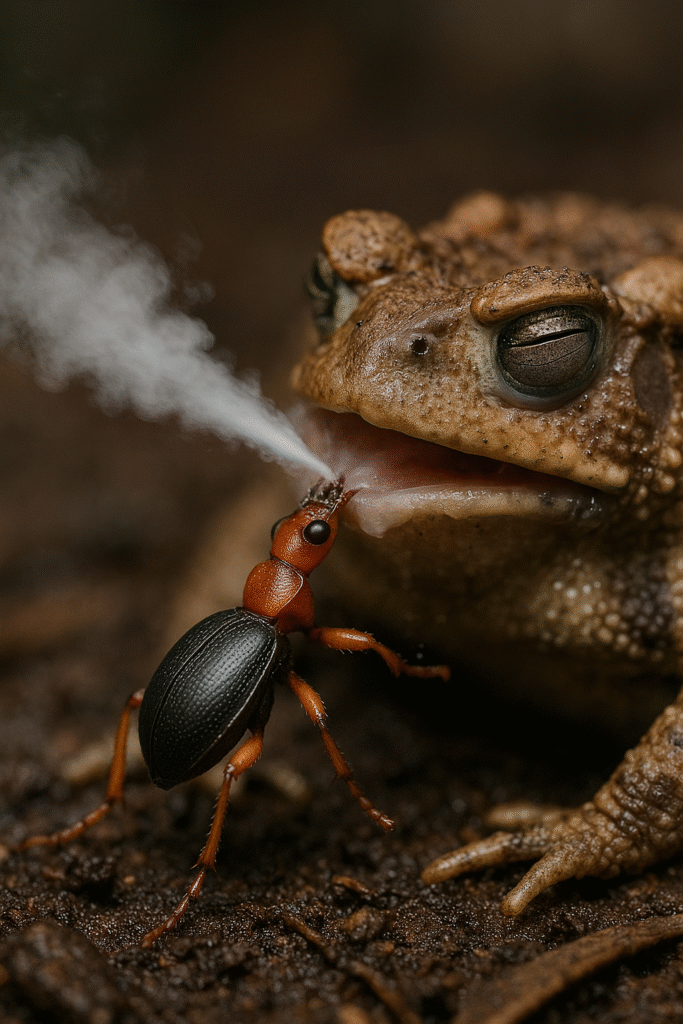
Predators do learn. Ants retreat to clean themselves; spiders release their prey; frogs spit the beetles out. In feeding trials, even naïve predators quickly acquire a lasting aversion to these beetles’ look and scent, an evolutionary advertisement suggesting, “Try someone else.”
Anatomy of Aim: The Living Turret
Effective defense demands precision. Bombardier beetles are famous for their aiming behavior: they arch the abdomen beneath the body or swing it laterally, tracking moving threats in real time. Muscles around the exit duct and fine control of abdominal posture give them a gimbal-like range. Some species can produce left–right differential pulses, essentially bracketing the target until contact is certain. It is not brute force; it is control.
A Family Tree of Fire
Bombardier chemistry does not appear from nowhere. The carabid family includes many beetles that secrete defensive chemicals. Across the tree, you find species with one or two of the system’s parts—quinones without heat, peroxides without pulse, storage without catalytic chambers. This mosaic suggests a stepwise evolutionary pathway: start with a bitter secretion, add oxidation for potency, separate reactants for stability, then evolve a reinforced chamber and valve for controlled reaction. What looks “irreducibly complex” is, in hindsight, incrementally assembled by selection—one small advantage at a time.
Places They Thrive
Bombardier beetles favor well-drained soils, open woodland, edges of wetlands, and the microtopography of stones and bark litter. Most are nocturnal wanderers, hunting small arthropods and scavenging. Their spray is not a sword for hunting; it is a shield. Some species aggregate under cover during the day, a reminder that for small animals, the world is divided into islands of safety and oceans of exposure.
Predator Encounters: Case Files from the Field
- Ants: A column engages; the beetle responds with rapid pulses, coating the lead workers. Ants recoil and begin frantic grooming, the column stalls, and the beetle walks away unhurried.
- Jumping spiders: A pounce becomes a retreat as the spider wipes its anterior eyes, vision compromised by sticky compounds. The beetle’s exhalations—tiny bursts of steam—vanish into the air.
- Frogs and toads: Perhaps the classic case. A tongue snap, a swallow,—and then the amphibian opens its mouth, shakes its head, and spits out a still-kicking beetle, which resumes walking, apparently unruffled.
Each encounter is a negotiation of cost. The beetle’s spray is expensive to synthesize. It uses it only when necessary, deploying a few pulses, then breaking contact.
Engineering Notes: What Designers Borrow
Biomimicry teams love the bombardier beetle for three lessons:
- Safe separation of reactants: Storing energetic chemicals in separate reservoirs increases shelf life and reduces accidental reactions—useful for pharmaceuticals and propellants.
- Micro-reactor design: The beetle’s reaction chamber is a self-regulating, pulsatile reactor with catalytic surfaces, suggesting approaches to microscale heat management and on-demand mixing in lab-on-a-chip devices.
- Pulsed jets: The pulsing that keeps the beetle safe also yields efficient bursts of thrust and spray—an instructive model for pulsed propulsion and atomization without complex moving parts.
Ethics and Philosophy: Power as Boundary, Not Conquest
In a world that often confuses force with virtue, the bombardier beetle proposes a different ethic of power: deterrence without domination. Its fire is not for conquest. It burns only the small circle of space needed to survive. Here lies a paradox rich with meaning: the gentlest lives may carry the fiercest defenses; resilience can be the art of setting limits, not the ambition to overrun them.
Across cultures, fire has been a double sign—of creation and judgment, hearth and hell. The beetle’s “inner fire” echoes those symbols but anchors them in biology. Its chemistry is not sin or miracle; it is adaptation—a solution to the problem of how to remain oneself in an injurious world.
The Life Around the Fire
For all the attention to its weaponry, a bombardier beetle spends most nights not spraying. It explores, feeds, mates, and navigates by touch and scent. Larvae are predatory, often soil-dwelling, hunting soft-bodied invertebrates. Adults clean their antennae, test substrates with palps, and shelter together when humidity and temperature fall. If you follow one by red light, its life reveals a quieter truth: the spray is a chapter, not the book.
A Short History of Misunderstanding
Naturalists once debated whether such heat could truly be generated in an animal so small. Lost in the argument was the fact that cells routinely harness exothermic reactions; the beetle merely scales and contains them. As research illuminated enzymes and chamber architecture, an old literature of skepticism gave way to admiration. The lesson is evergreen: nature often perfects what human intuition calls impossible.
Vulnerability, Revealed
For all its bravado, the bombardier is not invincible. Birds learn to flip and crush quickly, avoiding the nozzle. Some spiders pin the abdomen first. Extreme cold slows reaction kinetics; dehydration taxes the production of precursors. The beetle pays for every gram of chemistry it carries. Its survival is not a story of an unbeatable weapon, but of clever economics—spend when the returns are highest, hide when they are not.
Field Guide: How to See One (Without Getting Sprayed)
Look along trail edges after dusk with a headlamp. Watch for a quick, ground-hugging runner with a slightly bulbous abdomen and long legs. If you gently place a leaf in its path, it may pause and pivot the abdomen, a warning you should heed. Respect the beetle’s boundary and you’ll witness the posture without provoking the pyrotechnics. In hand? Best not. Your curiosity is admirable, but their deterrent works.
Culture, Art, and Metaphor
Artists have long borrowed the beetle’s combustion as metaphor: a quiet vessel with a volatile core. Writers cast it as Prometheus in miniature; designers sketch it as a living diagram of controlled reaction; educators use it as a story about the scientific method—observe, hypothesize, test, and be willing to be surprised. The beetle makes chemistry visible, audible, and unforgettable.
What the Bombardier Beetle Teaches
- Design: Separate, meter, and catalyze—then vent in pulses.
- Ecology: Deterrence shapes communities as surely as predation.
- Ethics: Strength can be the practice of holding a line, not crossing one.
- Humility: An insect solved safe energetic storage long before we did.
Closing: Fire, Kept
Standing over a damp trail at night, you might see one in profile: a small lantern of potential, walking the edge of danger with a secret furnace. The bombardier beetle is not about spectacle; it is about keeping what’s necessary close and contained. When the world presses in, it answers not with rage but with clarity: a measured, pulsed insistence on space to live.
It is chemistry, yes. It is also philosophy, written in heat.

Reply