
Deep within the dense Ituri rainforest of the Democratic Republic of Congo, there moves a creature so rare and enigmatic that for centuries it was whispered of as myth. To early explorers, it was the “African unicorn.” To local hunters, it was the “forest ghost.” Today we know it as the Okapi (Okapia johnstoni)—a mammal whose existence bridges the familiar and the fantastical.
A Creature of Contradictions
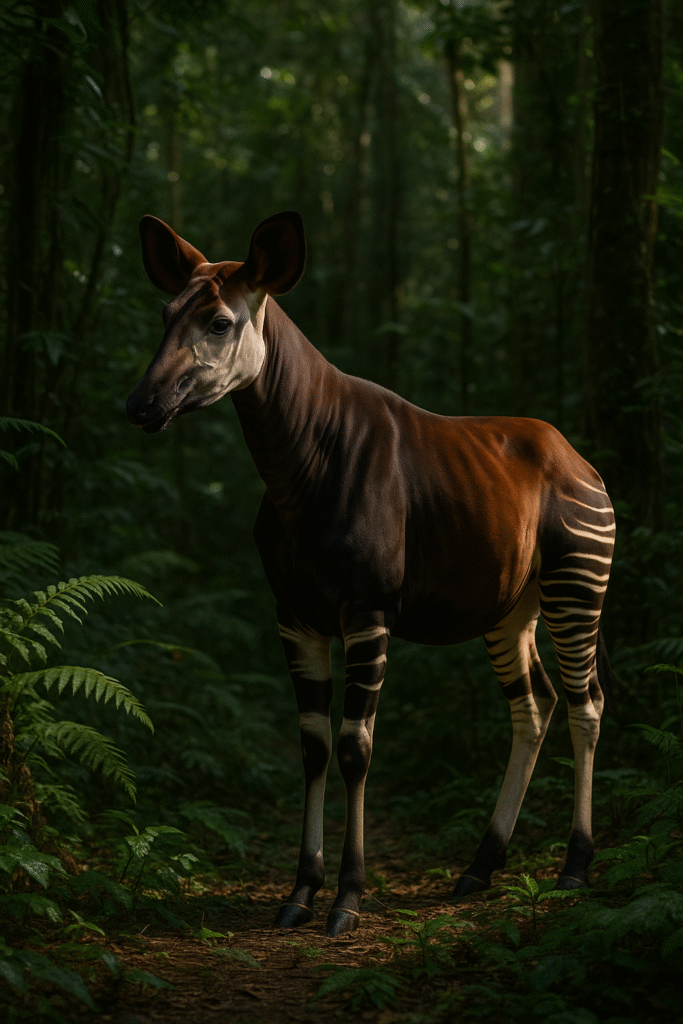
The okapi is a study in paradox. At first glance, its velvety chestnut coat and zebra-striped legs suggest an animal assembled from mismatched parts. Though often mistaken for a relative of the zebra, the okapi is, in truth, the giraffe’s only living kin. Its elongated neck, large, swiveling ears, and long prehensile tongue reveal the evolutionary echoes of its towering cousin, yet the okapi walks in shadow, preferring the solitude of the forest floor to the open savannah.
This duality—part zebra, part giraffe—has fueled its mystery for generations. Western science did not confirm its existence until the early 20th century, when specimens were finally brought to Europe. Until then, it lingered in the hazy borderlands between rumor and reality.
The Ghost in the Green
Okapis are masters of stealth. In a habitat where sunlight filters in fractured beams through thick rainforest canopy, their stripes serve not as spectacle but as camouflage, breaking up their outline against shafts of light and shadow. Their enormous ears catch the faintest rustle, allowing them to vanish silently into the undergrowth at the first hint of disturbance.
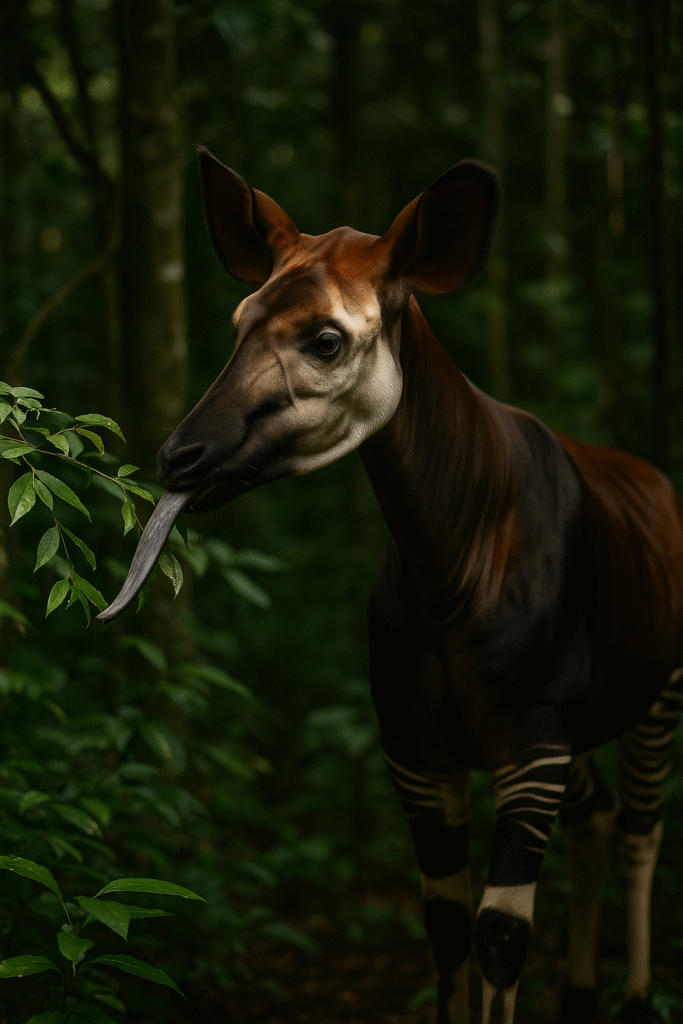
Unlike many mammals of their size, okapis are solitary by nature. They glide silently between trees, feeding on leaves, buds, fungi, and even clay for minerals. Their only regular company is the distant call of forest birds or, rarely, a calf tucked safely away in a secluded nest for weeks at a time while its mother forages.
Echoes of Myth and Memory
For the Congolese Mbuti people, the okapi has long held spiritual significance, regarded as a forest guardian and symbol of harmony with the wilderness. To colonial explorers, however, the okapi was proof of a living relic—an animal that defied Western understanding of Africa’s biodiversity. Its unveiling was hailed with the same astonishment that greeted the discovery of gorillas or the rediscovery of the coelacanth.
To this day, the okapi retains its aura of secrecy. Unlike elephants or lions, it has never been fully absorbed into global iconography. Instead, it remains a reminder that even in the 21st century, the Earth still harbors mysteries that resist easy capture or commodification.
Fragile in the Modern Age
Yet the okapi’s secrecy offers no shield against the threats of the modern world. Logging, mining, and civil conflict have fractured its rainforest refuge. Poaching and habitat loss have pushed the species to endangered status, with perhaps only 10,000–15,000 remaining in the wild. The Okapi Wildlife Reserve, a UNESCO World Heritage site, stands as one of the last bastions for this elusive mammal.
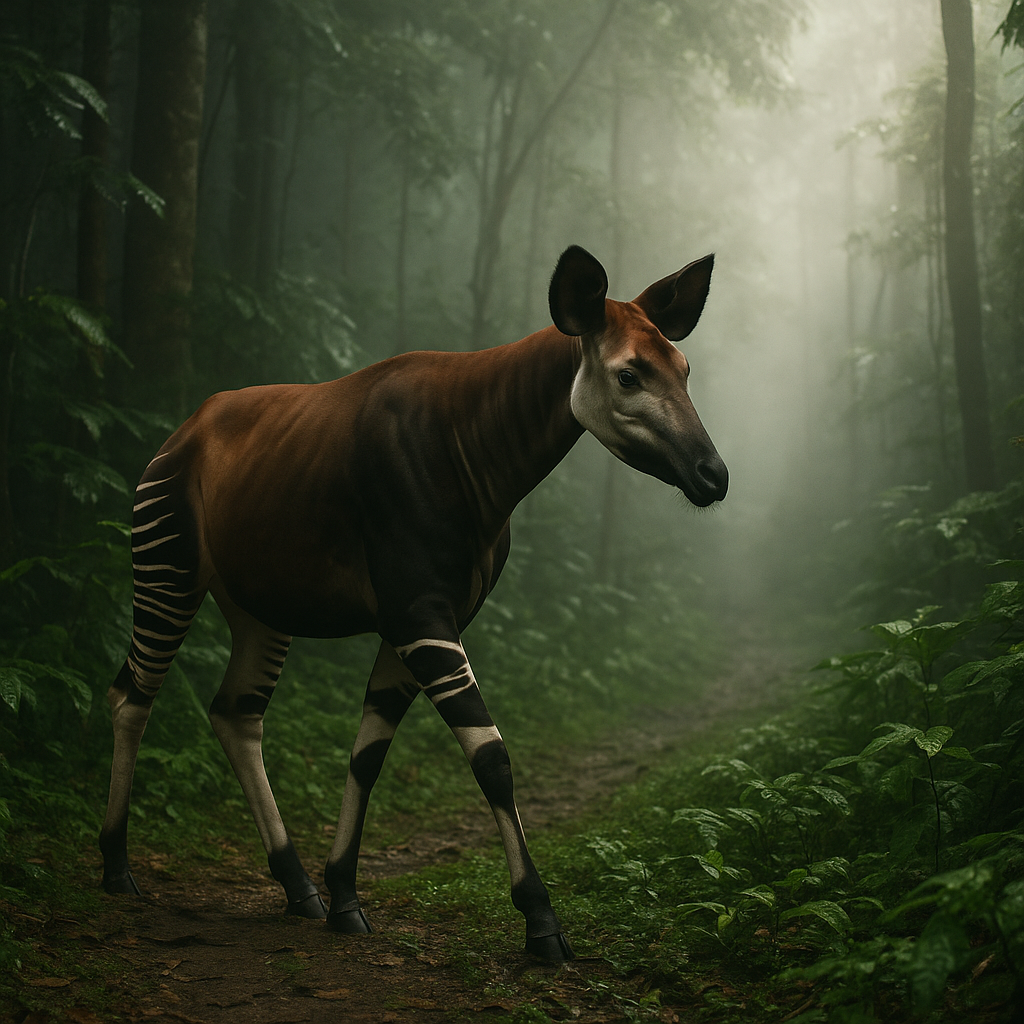
Its plight underscores a painful irony: the more elusive and delicate a species, the more easily it slips toward disappearance without the world even noticing. The “forest ghost” may vanish not with a roar, but with silence.
The Living Symbol of the Unseen
The okapi is more than an animal. It is a metaphor for the unseen—the truths hidden in shadows, the wonders still alive in places we rarely tread. In a world obsessed with speed and exposure, the okapi reminds us of the value of secrecy, stillness, and survival.
To encounter one in the wild is not just a sighting—it is a revelation, a glimpse into the rainforest’s hidden heart. The okapi is proof that some mysteries still walk among us, striped in silence, cloaked in shadow, waiting patiently to be remembered.

Reply