
Prologue: The Stillness Before Movement
There is a silence that belongs only to reptiles. A silence not of absence, but of presence — of stillness held so perfectly that it feels like the air itself is watching. A crocodile lies half-submerged in a river, its armored ridges breaking the water like the ruins of an ancient wall. A snake coils within leaves, its breath indistinguishable from the wind. A lizard clings to sunlit stone, unmoving, as though carved there by forgotten hands. And yet, in an instant, stillness becomes strike. This paradox — patience and suddenness, death and survival — defines the reptilian kingdom.
Deep Time: The Ancient Birth of Reptiles
Reptiles are not newcomers to Earth’s story. Their lineage stretches back some 320 million years, to the swamps of the late Carboniferous. In those damp forests, where amphibians ruled and insects grew to the size of birds, a new experiment unfolded in flesh: the amniotic egg.
This innovation — a self-contained world with shell, fluid, and nourishment — freed the first reptiles from the tyranny of water. They no longer needed ponds to cradle their young; they could carry entire ecosystems within their eggs and step boldly into deserts, plains, and mountains. From this single leap emerged a dynasty of forms: the colossal dinosaurs, the flying pterosaurs, the marine ichthyosaurs — and the ancestors of every snake, turtle, lizard, and crocodile alive today.
Reptiles were the architects of the Mesozoic Age, the “Age of Reptiles”, and though the great dinosaurs fell, fragments of their legacy endured, refined and resilient. To look at a crocodile’s eye is to glimpse the same gaze that once watched the rise and fall of entire continents.
Anatomy of Immortality
Reptiles wear the armor of time itself: scales. Composed of keratin, their scales shield against sun, water loss, and predators. But scales are more than defense — they are inscriptions of lineage, patterns carved by millennia.
Their cold-blooded metabolism is equally misunderstood. Where mammals and birds burn like furnaces, reptiles are slow fires. They conserve energy with ruthless efficiency, surviving on less food, enduring extremes where warm-blooded rivals falter. A crocodile may wait weeks between meals; a desert tortoise can survive months without water.
Then there are the marvels of specialization: snakes with venom glands that can kill or cure; lizards that shed tails to escape death; turtles carrying entire fortresses upon their backs. Reptiles do not conquer through speed or intellect but through endurance, adaptability, and patience — the truest currencies of survival.
Masters of the World’s Biomes
There is no corner of Earth untouched by their presence.
- In rivers and swamps, crocodiles reign as ancient sovereigns. They are engineers of fear and balance, culling the weak, shaping aquatic life.
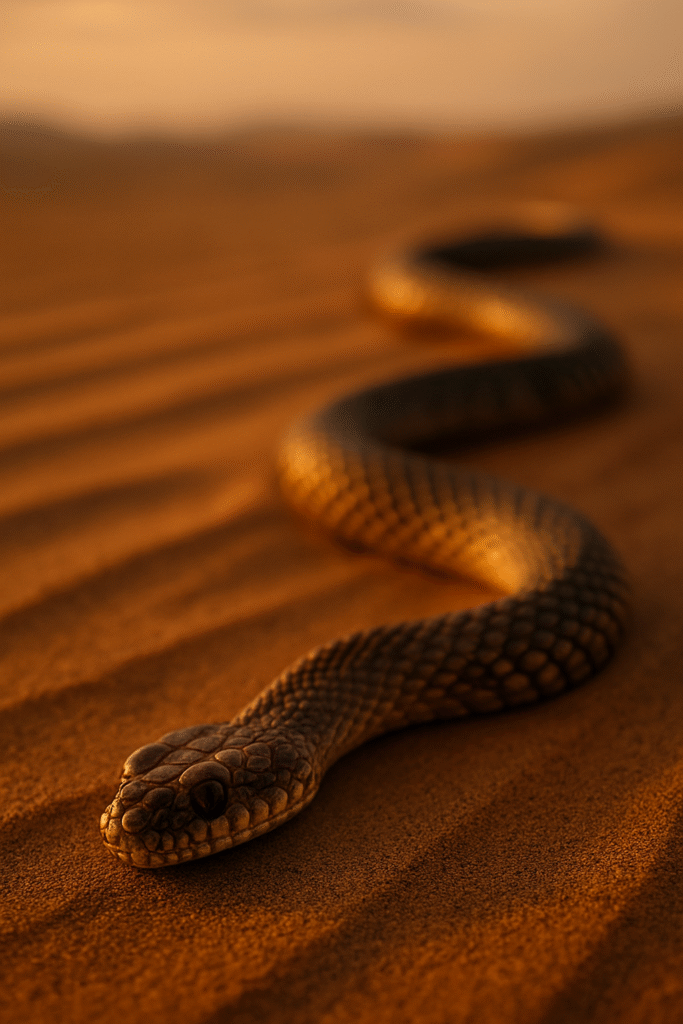
- In deserts, snakes vanish into sand like living hieroglyphs, conserving every drop of water, writing survival in the language of silence.
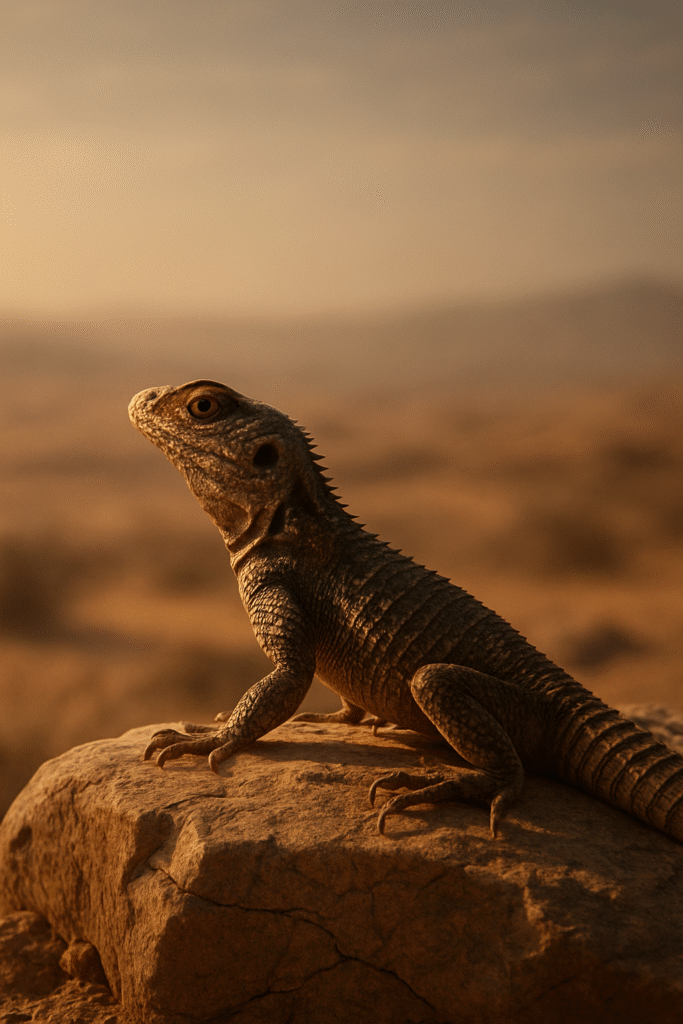
- In forests, lizards dart among roots and branches, tiny but vital regulators of insect and plant life.
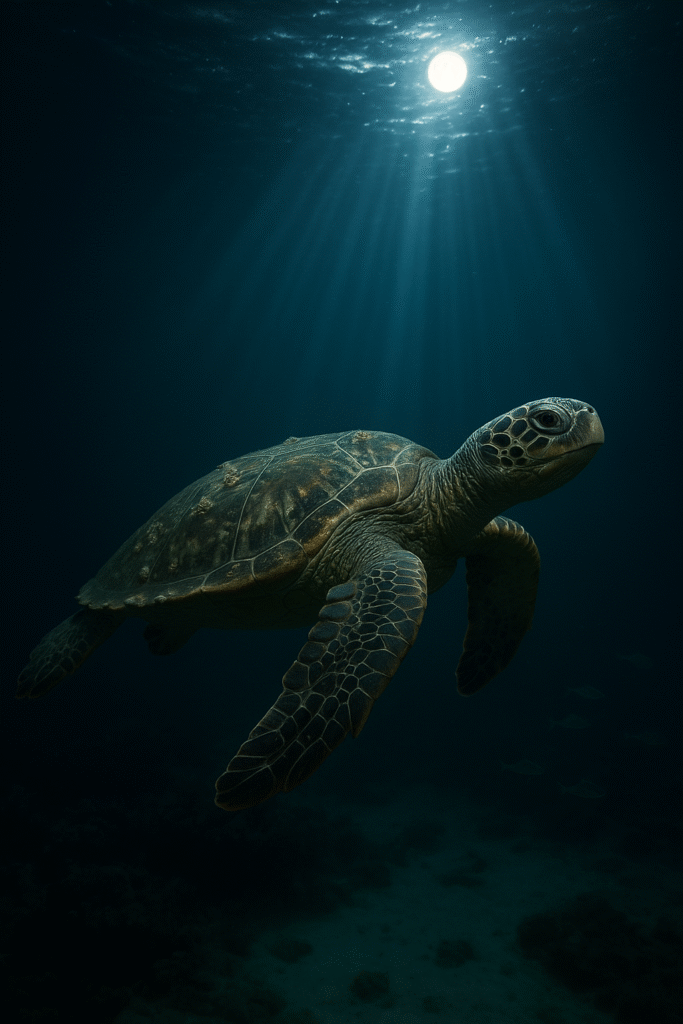
- In oceans, sea turtles glide across entire hemispheres, linking continents through their migrations.
Every biome holds a reptilian ghost, a presence that endures where others collapse.
Reptiles in Human Imagination
Humanity has never been indifferent to reptiles. They haunt our myths as symbols of fear, wisdom, and eternity.
- Serpents slither through every mythology: the cobra around Shiva’s neck in Hindu lore; the serpent in Eden whispering temptation; the Ouroboros swallowing its tail, a symbol of eternity.
- Dragons, though mythical, are reptilian in essence. Scaled, winged, fire-breathing — they embody humanity’s awe of reptile power, expanded into cosmic archetypes.
- Crocodiles became gods: in Egypt, Sobek of the Nile was feared and worshipped, his temples filled with mummified crocodiles offered in devotion.
- Turtles carry worlds on their backs in Chinese, Hindu, and Native American cosmologies, embodying patience, balance, and cosmic stability.
Wherever humans told stories, reptiles slithered into the script.
Reptiles in Antiquity and Civilization
Civilizations did not merely fear reptiles; they built around them.
The Egyptians cultivated entire crocodile cults along the Nile, raising and embalming them as avatars of Sobek. In Mesoamerica, the feathered serpent Quetzalcoatl embodied creation and renewal, linking sky and earth. The Greeks peopled their myths with serpentine guardians — dragons that watched over golden apples and sacred springs.
Medieval Europe turned reptiles into villains. Serpents became Satan’s embodiment, dragons stood as foes of saints. Yet, even in this demonization, reptiles were acknowledged as beings of immense symbolic gravity.
Modern Science & Conservation
Today, herpetology — the study of reptiles and amphibians — reveals truths that are both wondrous and urgent. Reptiles are ecological barometers. Their presence or absence tells us of climate shifts, pollution, and ecosystem health.
But they are also imperiled. Habitat loss, hunting, the pet trade, and climate change place thousands of reptile species at risk. The leatherback turtle, once spanning oceans, now teeters on the brink. Many snake species are vanishing before they can even be studied.
Yet hope exists. Sea turtle hatchling programs, crocodile sanctuaries, and snake venom research for medicine all show that the reptilian legacy can be safeguarded — if reverence replaces exploitation.
Philosophical Reflections
What do reptiles teach us?
They are reminders of deep time — of lives measured not in moments, but in epochs. They embody patience, existing in a rhythm alien to our urgency. They are symbols of duality: feared and worshipped, slow yet sudden, ancient yet alive.
To sit before a reptile is to face a mirror tilted toward eternity. They do not charm us with warmth or mimicry; they compel us to confront survival stripped bare, existence reduced to essence.
Closing Vignette
Beneath the moon, a sea turtle rises from the waves. Its carapace gleams with silver light, barnacles etched upon its shell like constellations. It does not hurry, does not falter. With slow, eternal strokes, it disappears into the dark, a living fragment of prehistory gliding through the present.
In its wake, the water shimmers and then stills, as though nothing had passed. And yet something ancient remains — the echo of scales, the whisper of eternity.

Reply