
In the rainforest, survival takes many forms: the fang, the claw, the wing, the sting. Yet there is one creature that thrives not by standing out, but by dissolving into the very fabric of its surroundings. This is the Goliath Stick Insect (Eurycnema goliath), one of the largest walking sticks on Earth—an insect that can stretch to nearly thirty centimeters in length, yet vanish entirely in plain sight.
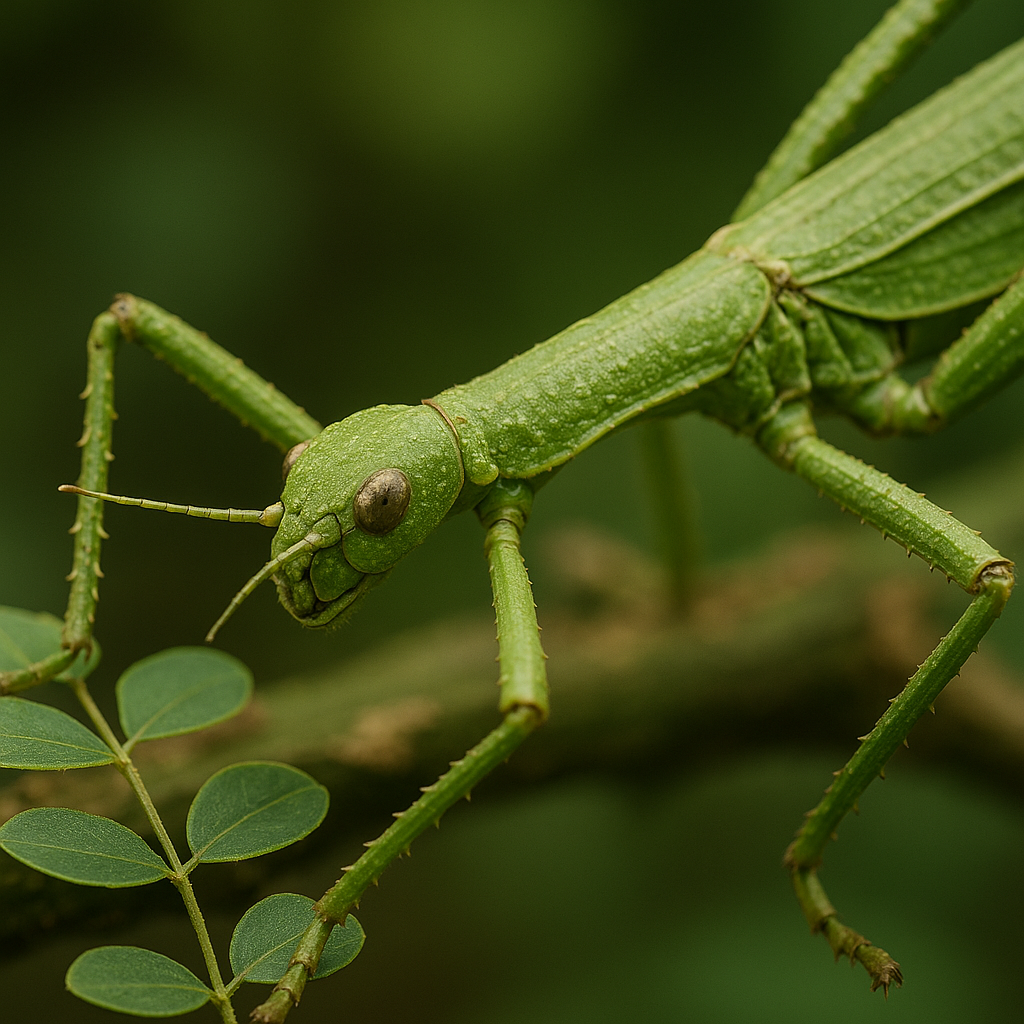
To see it is to doubt your own eyes. Was that a twig swaying in the breeze, or something alive?
Anatomy of Disguise
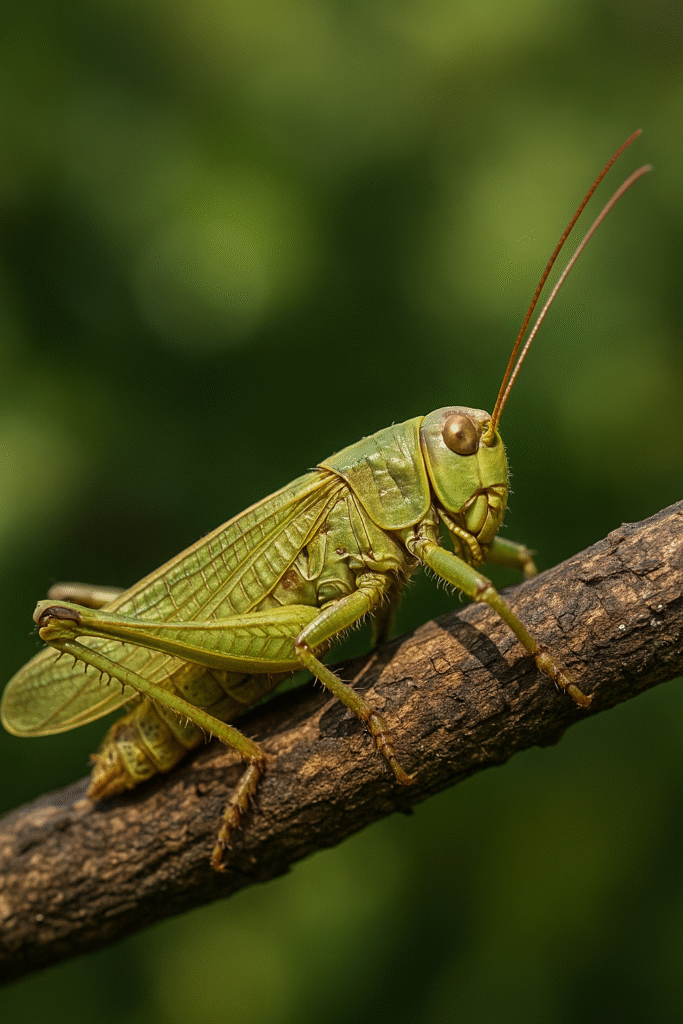
The Goliath Stick Insect is a masterwork of natural design. Its body is elongated, angular, and textured, mimicking the exact form of forest twigs and branches. Females, the larger of the sexes, can be as long as a human forearm, with wings patterned like green leaves. Males, slimmer and shorter, rely even more heavily on stillness and camouflage. When both genders hold motionless on a branch, they simply cease to exist to predators.
The Silent Ritual of Survival
By day, these phantoms remain still, resting among the foliage, their very lives hanging on their invisibility. By night, they move cautiously, feeding on the leaves of eucalyptus, acacia, and other canopy trees.
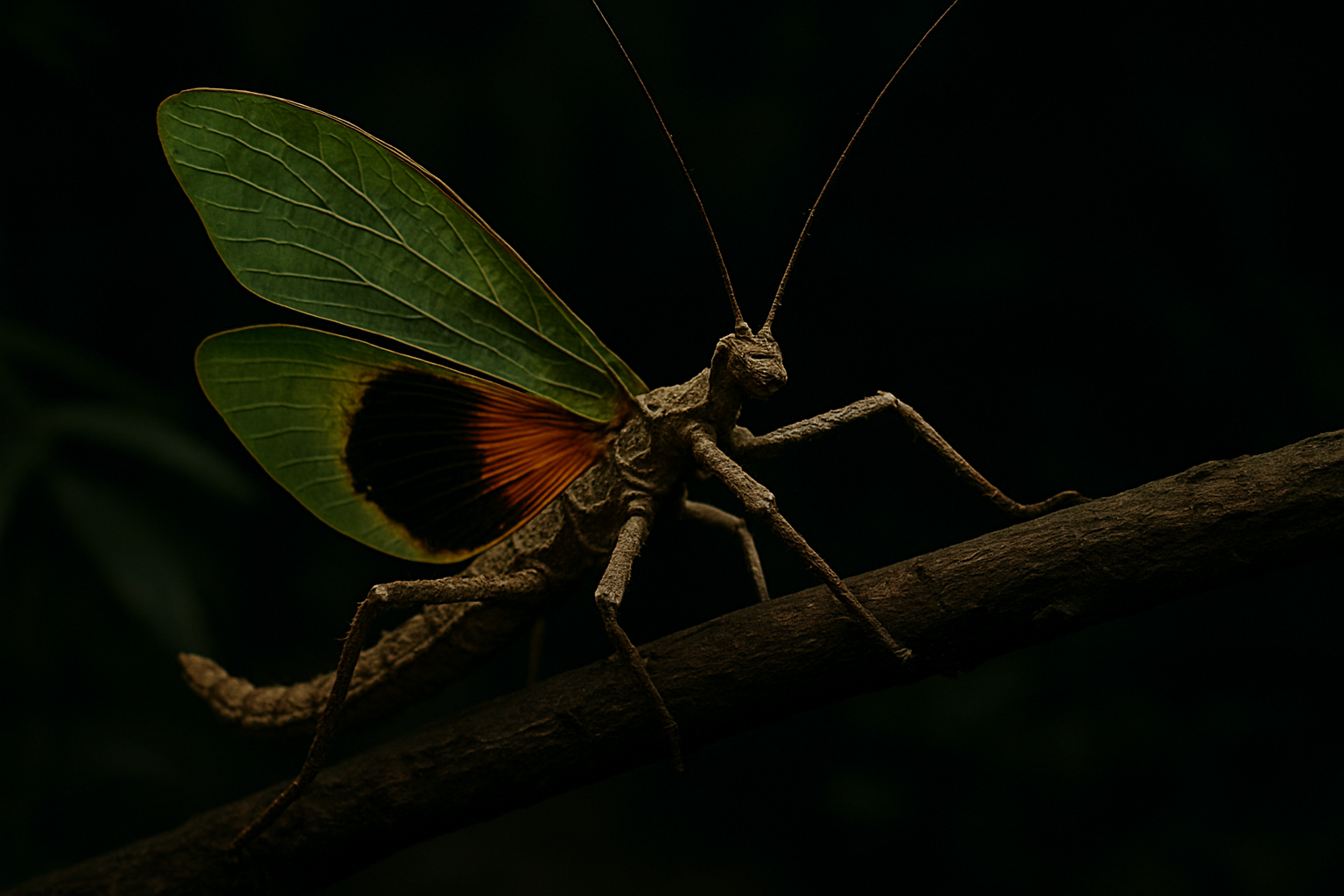
When threatened, they can engage in catalepsy—a dramatic feigned death, legs drawn in, body frozen, as if nothing more than a discarded twig. Some species flash bright underwings, often blood-red or golden, in a sudden shock display that startles predators before the insect vanishes once more into stillness.
Cultural Footprints
Throughout human history, stick insects have invited awe. In Southeast Asia, they are sometimes seen as forest guardians, humble spirits reminding us of the power of patience and invisibility. In the modern age, they have become exotic pets, carefully bred by enthusiasts, admired not for ferocity, but for their quiet strangeness.
The Goliath Stick Insect, in particular, stands as a symbol of paradox: colossal in size, yet almost unseen.
Fragility of the Invisible
Paradoxically, invisibility does not shield them from us. Logging, deforestation, and agriculture strip away their habitats, leaving even these masters of disguise exposed. Though not currently classified as endangered, populations are increasingly vulnerable, especially as the exotic insect trade grows.
The lesson is stark: camouflage can hide you from a predator, but not from chainsaws.
The Deeper Reflection
What does it mean that one of the world’s largest insects survives by disappearing? The Goliath Stick Insect is not a warrior or a conqueror. It does not fight for dominance. Instead, it embodies an ancient truth: survival can come from humility, from silence, from becoming part of something greater than oneself.
To glimpse one in the wild is to see the forest itself breathe. The insect is not merely in the forest. For a moment, it is the forest.
✨ This is the Goliath Stick Insect: a giant, a ghost, and a teacher. Proof that in the natural world, greatness is not always about being seen.

Reply