
Rare moment: when a stone opens an egg
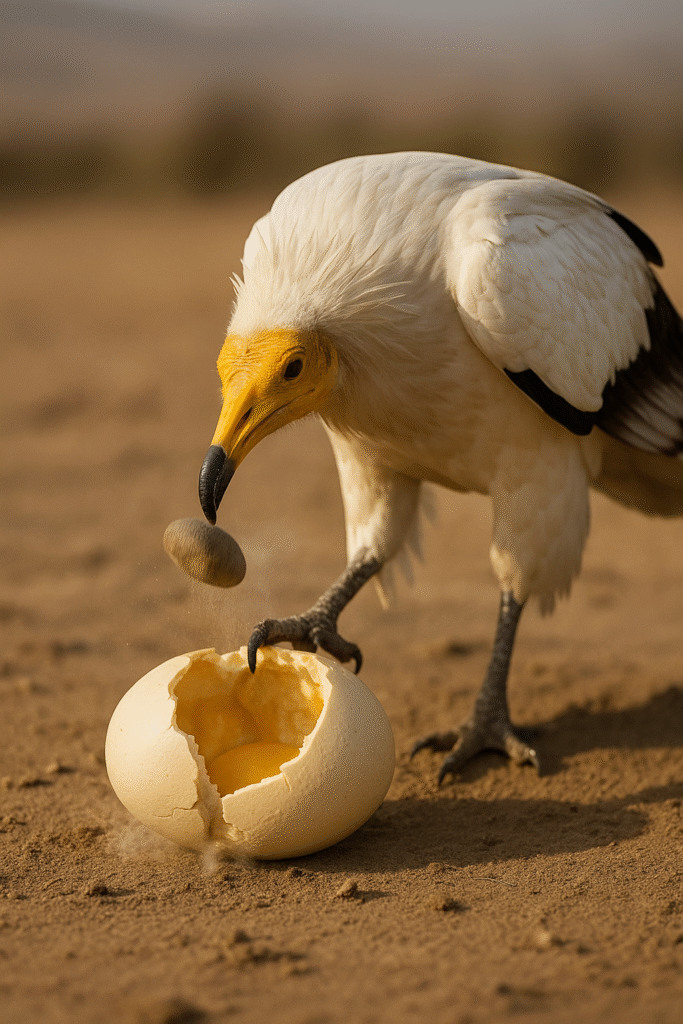
Heat wavered over a Sahel pan. In the center lay a sun-bleached ostrich egg—too thick for talons, too tough for a beak. A white-and-black raptor trotted in, picked up a smooth pebble, and hammered the egg until the shell spidered and caved. The bird stepped back, dipped its bill, and fed with the prim posture of a surgeon. Few wild scenes feel as old as that: a vulture using a tool on an African plain, doing what its lineage has likely done for millennia.
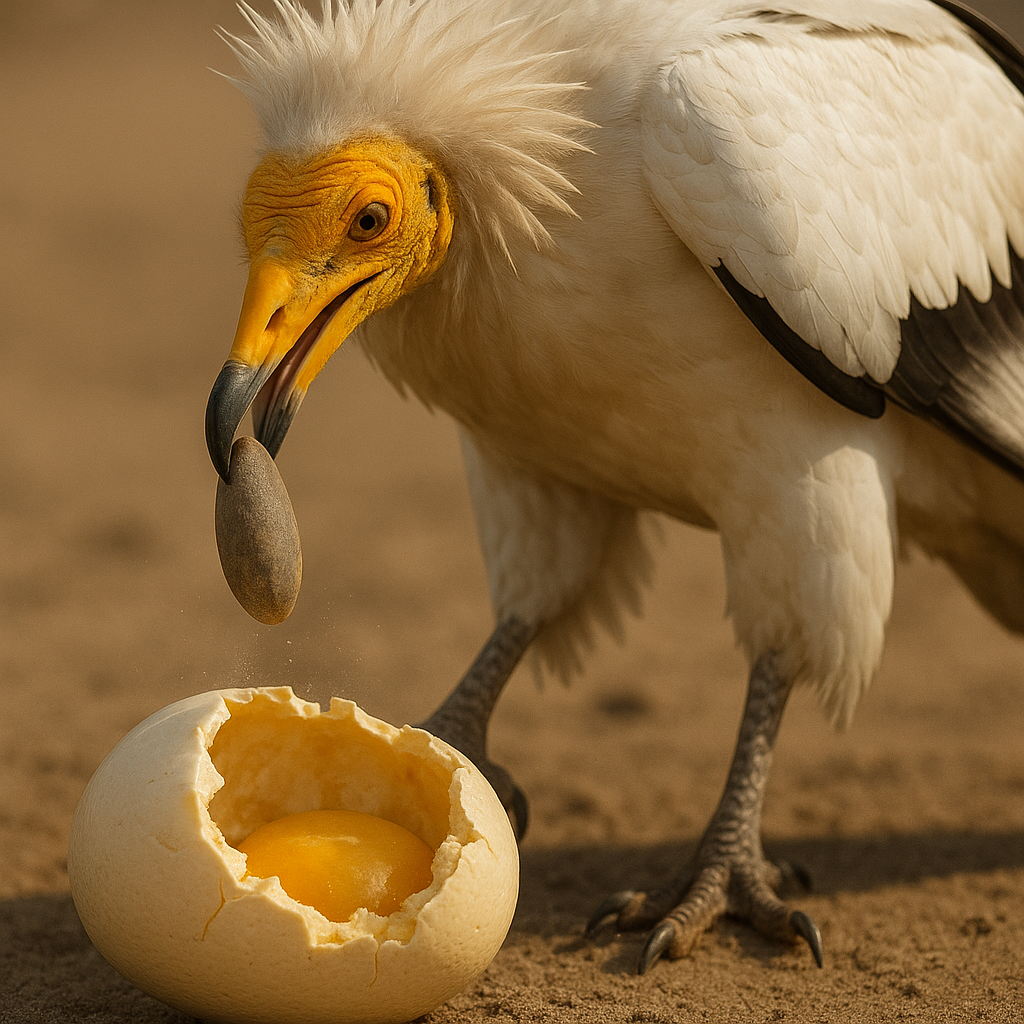
That bird is the Egyptian vulture—smallest of the Old World vultures, longest in cultural memory, and one of the most surprising minds in the desert sky.
1) Identity: what it is (and isn’t)
- Look: Adults wear a crisp white cloak with black flight feathers and a bare lemon face; the bill is slender, ending in a neat hook. Juveniles are a stealth version—chocolate-brown to soot-black, mottled and inconspicuous.
- Size: Wingspan ~1.6–1.7 m; light for a vulture, built less like a condor and more like a glider with a scholar’s neck.
- Range: Breeds from the Mediterranean through the Balkans, Caucasus, Arabia, and the Horn of Africa; winters primarily in the Sahel and Northeast Africa. Island populations (e.g., Canary Islands) are largely resident.
- Diet: Classic opportunistic scavenger—carrion, eggs, insects, small vertebrates, fish offal, livestock placenta, and village scraps.
- Superpower: Tool use. It wields stones to break large eggs and uses twigs to roll up wool for nest lining. That behavioral plasticity is rare among birds of prey.
2) Legacy of antiquity: the bird that wrote protection into stone
Ancient Egypt carved vultures into the grammar of power. The vulture hieroglyph stood for a sacred sound and was bound to Nekhbet, protector of Upper Egypt—often shown as a vulture with wings outstretched above the pharaoh’s crown. On temple ceilings, the bird flies as a ceiling of guardians; on jewelry, it becomes a torque of feathers and gold. To the Nile world, the vulture was not death but maternal protection—a wide embrace.
That symbolism endured because people watched the same behaviors we do now: a white figure sweeping above floodplains, tidying what would rot, visiting villages without fear, nesting on cliffs like a sentinel at the edge of law and sky. Of all the raptors we meet today, none carries a clearer thread from myth to field guide.
3) A day in the life: a scholar of edges
The Egyptian vulture prospers in ecotones—edges where one thing becomes another: desert into oasis, steppe into village, cliff into plain. Morning starts with a roost check—the pair preens, sunbathes with wings angled like a book opened to light, then rides thermals over routes that braid wild carcasses and human leftovers. It walks more than most raptors, picking along tide lines, dung piles, even beetle swarms stirred by livestock. Where large vultures dominate carcasses, it specializes: arrives first to small finds, stays last to glean tendon and skin, switches diets with seasons.
Nests are old stone libraries: dry sticks, wool, and found objects (sometimes colorful trash) wedged into a ledge that faces wind but not rain. The pair repairs the nest for years; young learn this address as their first definition of home.
4) Survival battles: the light glider versus heavy guildmates
At carcasses, the Egyptian vulture reads the physics of danger. Griffons spiral down like heavy kettles; eagles drop like axes. The smaller vulture keeps lateral space, watching for the opening that lasts only seconds—when a larger bird steps aside or a tendon line loosens. A quick stab, a back step, a hop; it survives by footwork, not force.
In the Sahel’s dry heart, scarcity sharpens the contests: jackals, marabou storks, and hyenas share the same ledger. On egg days the tool breaks the tie; on fish days a clever walk along drying channels finds dinners bigger birds ignore.
5) What you didn’t know (and will remember)
- One of the few tool-using raptors. Stone-hammering isn’t trained; it’s innate, refined by practice.
- Migratory marathons. Balkan birds can cross Sahara widths in weeks, timing departures to winds and dust.
- Juvenile camouflage. Brown plumage buys teenagers a year of safety—other raptors ignore what doesn’t shine.
- Bone-cleaners by design. Narrow bills can thread sinew and reach marrow scraps missed by larger species.
- Village ally. Traditional herding landscapes—open dumps, slaughter days, free-ranging goats—used to feed them; hyper-sanitized towns create food deserts for scavengers.
- Lead hazard. Fragments from lead bullets in carcasses deliver micro-doses that add up to paralysis.
- Power-line risk. Light, wide wings and cliff winds make electrocution a major killer on poorly designed poles.
- Egg palette. Their own eggs are boldly speckled, camouflaged even in light nests.
- Family fidelity. Pairs often mate for years, reusing ledges across generations—heritage by address.
- Symbol with teeth. In several cultures they’re still considered good omens, a public-relations advantage we should wield.
6) Emotional rescue: the lead-poisoned white ghost
The vulture was hunched at a village dump, eyes bright but legs rubber. When it tried to lift, the wings obeyed and the feet did not. We brought it to a local clinic—no drama, just chelation therapy and fluids. The staff placed it in a quiet box; hands were slow and few. Day three, the feet gripped; day five, it stepped to the perch; day eight, we hiked to a cliff where a mate had been circling at dusk. The release was no cinematic swoop—just a firm, level glide into a thermal that turned white feathers silver. Two loops later, two birds were the same size in the sky.
Rescue protocol (for trained teams only): minimal handling, x-ray for fragments, chelation under vet supervision, quiet recovery, release near the original territory to give pair-bond a chance.
7) Migration: a moving inheritance
Spring drags Saharan dust north; thermals bloom; the birds rise. Telemetry shows arrow-straight crossings and river-following detours depending on wind years. Bottlenecks—Strait of Gibraltar, Bosporus, Suez—turn air into a highway of wings: kites, storks, buzzards, and these white accents threading through. First-year birds push farther south; experienced adults are conservative, landing at known refueling oases that may be a single artesian well or an abattoir the size of a tennis court.
If one of those nodes closes—well capped, dump sealed, pole uninsulated—the chain stutters. Migration is not just distance; it is a necklace of places. Break enough beads and the thread spills.
8) Threats: the modern ledger of losses
- Food sterilization: Sanitation policies that remove all organic waste leave no safe carrion; poisoned bait for predators takes vultures as collateral.
- Toxins & vet drugs: Lead from ammunition; NSAIDs used in livestock (some painkillers are lethal to vultures); accidental poisoning at predator carcasses.
- Electrocution & collision: Unsafe poles in cliffy wind corridors; poorly sited wind turbines at migration pinch points.
- Direct persecution: Superstitions in a few regions still drive killings; egg collecting persists at a trickle.
- Habitat change: Cliff quarrying, nest disturbance by recreation, shrub encroachment at traditional foraging flats.
- Climate stress: Sahel drought compresses food; dust storms and heat waves raise travel costs.
9) What works (field-tested, practical)
- Vulture-safe power lines. Insulate cross-arms, widen clearances, and retrofit poles at cliff rims and wadis first—the highest return per pole.
- Lead-free ammunition in hunting and pest control. Stops poison at the source.
- “Clean carrion” programs. Designated, veterinary-safe carcass sites (far from roads) that replace dangerous dumps with predictable, safe food.
- Community stewards. Pay herders to report nest sites, guard cliffs during breeding, and call in injured birds.
- Tourism with rules. View from set distances; no drones at nests; contribute to a cliff fund that underwrites retrofits and rescues.
- Save the nodes. Protect and manage the few refueling oases and slaughter points that still feed a flyway—small dots, huge impact.
10) Majestic photography + storytelling (pro tips)
- Light: Side-lit mornings turn white into sculpted feathers; avoid harsh noon.
- Behavior frames: Stone-throwing at eggs, sunning with wings drooped, courtship food passes on ledges.
- Lens: 400–600 mm; prioritize ethics over pixels—if the bird watches you more than the horizon, you’re too close.
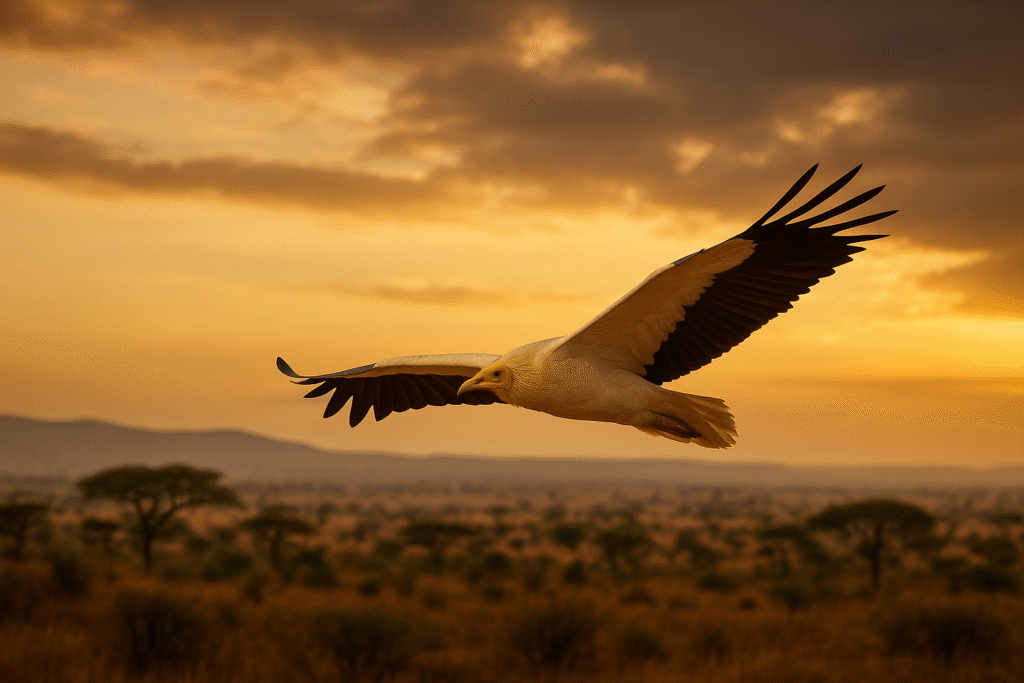
- Alt text ideas: “Egyptian vulture carrying stone to crack ostrich egg,” “Adult Egyptian vulture soaring over Sahel scrub,” “Juvenile Egyptian vulture, dark plumage, perched on basalt ledge.”
11) Symbolism, culture, mythology: from crown to cliff
To Egyptians, the vulture’s outstretched wings literally crowned authority; for desert families today, it still crowns good fortune—a white bird over a wedding camp, a clean carcass after a difficult lambing. In both stories the role is the same: protector and purifier. The legacy of antiquity is not a museum piece; it is a behavior we can watch any dry season—wings sheltering a nest, a valley, a memory.
12) Field guide (fast facts for readers)
- Name: Egyptian vulture (Neophron percnopterus)
- Status: Endangered globally; some regions Critically Endangered
- Age: Up to ~30 years in the wild; first breeding often after age 5
- Clutch: Usually 1–2 eggs; both parents incubate and feed
- Best chances to see: Spring/fall migration bottlenecks; dry-season cliffs near villages or traditional grazing; Canary Islands year-round
- Tell it from others: smaller, white body with black primaries, yellow face, wedge tail, and a walking habit unusual among vultures
13) Personal narrative + moral: the letter, still airborne
On the last evening of fieldwork, we hiked to an overlook above a basalt escarpment. Heat leaked from the stone like old breath. A pale bird curled out of shadow and lifted into amber light—two slow beats and then glide, glide, reading the thermals like Braille. It crossed above us, face bright as a lemon slice, and I thought of the artisans who cut the vulture into temple ceilings three thousand years ago. Their bird has not vanished into myth. It is still on patrol—a living hieroglyph that means: protect, purify, persist.
Our century will decide whether that sentence keeps its subject. The fixes are boring, local, and entirely possible: safer poles, cleaner carrion, lead-free bullets, a handful of protected oases. Do the ordinary things well and the extraordinary will continue overhead.
FAQ
Is the Egyptian vulture dangerous to people or livestock?
No. It is primarily a scavenger and cleaner; it poses no threat to healthy animals or humans.
Do all individuals use tools?
Stone-throwing is widespread where large eggs are available; not every bird encounters them, but the ability is there.
Why are juveniles dark?
Camouflage and thermoregulation. Darker birds absorb morning heat and avoid harassment from dominant raptors.
Can reintroductions work?
Yes—but only with power-line retrofits, safe food, and local guardians; otherwise releases are just expensive flights.
What can readers do from home?
Choose lead-free ammunition if you hunt; support projects that retrofit dangerous poles; back community programs guarding key cliffs and oases.
Closing
The Egyptian vulture is the legacy of antiquity made feather and will—an ancient letter still legible against a modern sky. If we keep the script—safe places, safe food, safe flight—the letter keeps writing itself, season after season, from cliff to village to desert rim. And somewhere, under a heat-shimmered sun, a small white vulture will pick up a stone, tap a shell, and remind us that intelligence and tradition can coexist on the same wing.

Reply