
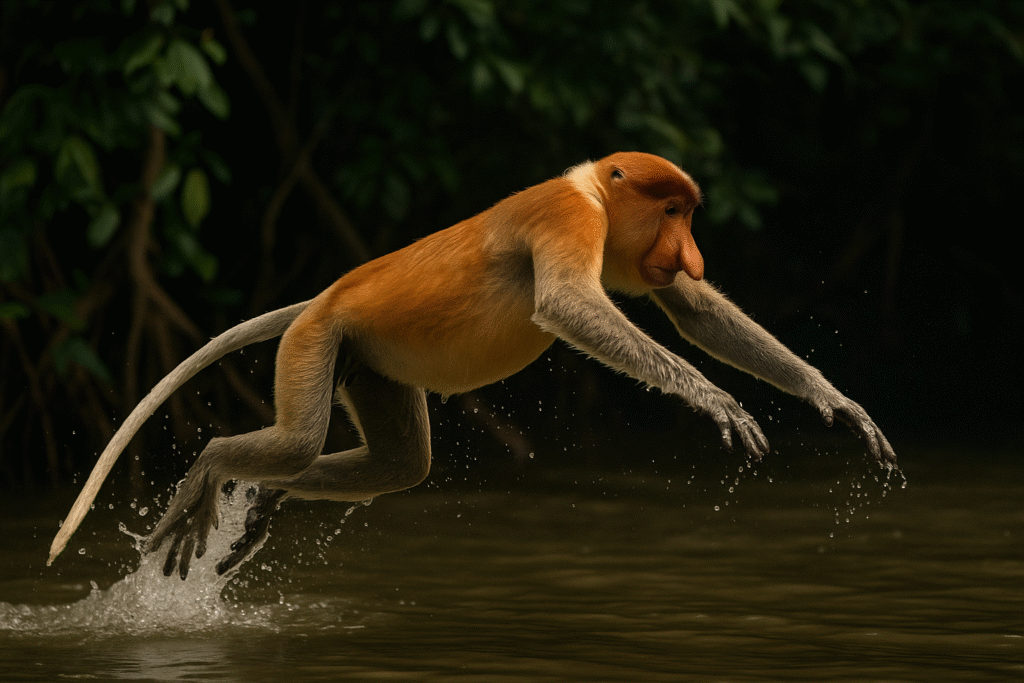
In the heart of Borneo, where tangled mangrove roots grip the edges of winding rivers and the air hums with the chorus of cicadas, a figure leaps between branches. It pauses on a high perch, its long limbs taut with strength, its fur a deep russet against the green. Then you see it—the nose. Long, pendulous, impossible to ignore. This is the proboscis monkey (Nasalis larvatus), one of the most unusual primates on Earth.
At first, it might provoke laughter. But to watch the proboscis monkey long enough is to feel awe instead—at its beauty, its adaptations, and its role as a guardian of fragile ecosystems.
A Portrait of Peculiarity
The proboscis monkey is instantly recognizable. Adult males sport a nose so large that it sometimes hangs past their mouths, while their pot-bellied torsos give them a comical silhouette. Yet this “oddness” is the result of millions of years of evolution in one of the planet’s most competitive environments: the mangrove swamps and riverine forests of Borneo.
The swollen belly, once mocked by early naturalists, is no accident. Proboscis monkeys are foregut fermenters—their stomachs resemble those of cows, with multiple chambers hosting specialized bacteria to break down the tough cellulose of mangrove leaves. This adaptation allows them to thrive on a diet that would kill most other primates.
And that nose? Far from useless, it’s a tool of power. Larger noses amplify vocalizations, giving dominant males deeper, more resonant calls that carry through the forest. Females prefer these calls, associating them with strength, health, and protection. What seems like an absurd burden is in fact a badge of authority.
Life in Two Worlds: Trees and Water
Unlike most monkeys, the proboscis monkey is just as comfortable in water as in the canopy. With partially webbed feet, they are powerful swimmers, able to cross wide rivers, sometimes even against strong tides. Observers have seen entire troops diving into the water, vanishing beneath the surface, and reemerging meters away, safe from predators.
This amphibious lifestyle is rare among primates and underscores their intimate connection with mangrove ecosystems. While other monkeys are confined to trees, proboscis monkeys move between land and water with ease, occupying a niche no other primate fills. In doing so, they act as keystone dispersers—their constant browsing shapes the regeneration of mangroves, swamps, and riverside vegetation.
The Social Order
Proboscis monkeys live in harem groups, typically composed of a dominant male, several females, and their offspring. Young males, once expelled from their birth groups, form all-male “bachelor bands” until they are strong enough to challenge a leader.
Within these troops, bonds are strong. Mothers groom daughters, juveniles play in the branches, and males defend their families fiercely with honks, branch-shaking, and, if necessary, full combat.
Even here, the nose is central. Males use it to produce loud honks, but also to express emotion—flaring, swelling, or drooping depending on mood. The nose, oddly enough, is a language of its own.
Folklore and the Human Imagination
The proboscis monkey has fascinated the people of Borneo for centuries. In local stories, it is sometimes described as a trickster spirit, clumsy yet cunning, a reminder that the forest is full of humor as well as danger.
Colonial settlers, noticing the monkeys’ large noses and reddish coats, mockingly nicknamed them “Dutch monkeys.” But for indigenous communities, the proboscis monkey has deeper meaning: it is seen as a guardian of rivers, a creature whose presence signals fertile waters and healthy mangroves. Killing one was once considered taboo, an act that could bring misfortune.

Thus, the monkey straddles two roles: comic figure and sacred being, an animal that mirrors both human folly and ecological wisdom.
On the Edge of Survival
Despite their resilience, proboscis monkeys are in peril. Borneo’s forests have been devastated by palm oil plantations, logging, and human settlements, leaving the monkeys with fragmented habitats. Without continuous mangroves, troops become isolated, unable to find enough food or safe corridors for movement.
Poaching, though less common than habitat loss, still occurs, with monkeys sometimes killed for bushmeat or in retaliation for crop raiding. Today, the species is listed as Endangered, with fewer than 7,000 individuals estimated to remain in the wild.
The proboscis monkey’s plight is also the plight of the mangroves. These forests are vital not only for wildlife but for humans too: they protect coasts from erosion, buffer storms, and store carbon at rates far higher than terrestrial forests. To lose the monkey is to lose the forest, and to lose the forest is to lose a shield against climate collapse.
Echoes of Conservation
Yet, hope remains. In places like the Kinabatangan River in Sabah, Malaysia, ecotourism has transformed perception. River cruises bring travelers face-to-face with these remarkable monkeys, generating income that incentivizes protection.
Community-led conservation groups are planting mangroves, creating protected corridors, and teaching younger generations that the proboscis monkey is not just a curiosity, but a national treasure. Conservationists now describe the species as a flagship animal for wetland protection, a charismatic emblem whose survival ensures the survival of countless other species.
Lessons from the Nose
The proboscis monkey teaches us that beauty can take strange forms. Its belly, once mocked, is a marvel of digestion. Its nose, once ridiculed, is a trumpet of power. Its awkward leaps and comic dives hide the grace of a creature perfectly adapted to a challenging world.
And perhaps most importantly, its story shows that even the strangest beings carry immense ecological weight. The nose is not a joke—it is a reminder that survival often comes from unexpected places.
Conclusion: Laughter, Awe, and Responsibility
To see a proboscis monkey in the wild is to experience a spectrum of emotions: laughter at its comical looks, awe at its power, and sadness at its vulnerability. It is a species that demands respect, not ridicule, for in its survival lies the fate of forests, rivers, and the human communities who share them.
The proboscis monkey stands as a guardian of the tides, a creature that embodies humor, resilience, and wisdom. Its trumpet-call across the mangroves is not just a mating song—it is a warning, a plea, and a hope all at once.
If we listen closely, we may hear not only the call of the monkey, but the voice of the mangroves themselves: protect us, and we will protect you.

Reply