
Rare moment — rain on a green cathedral
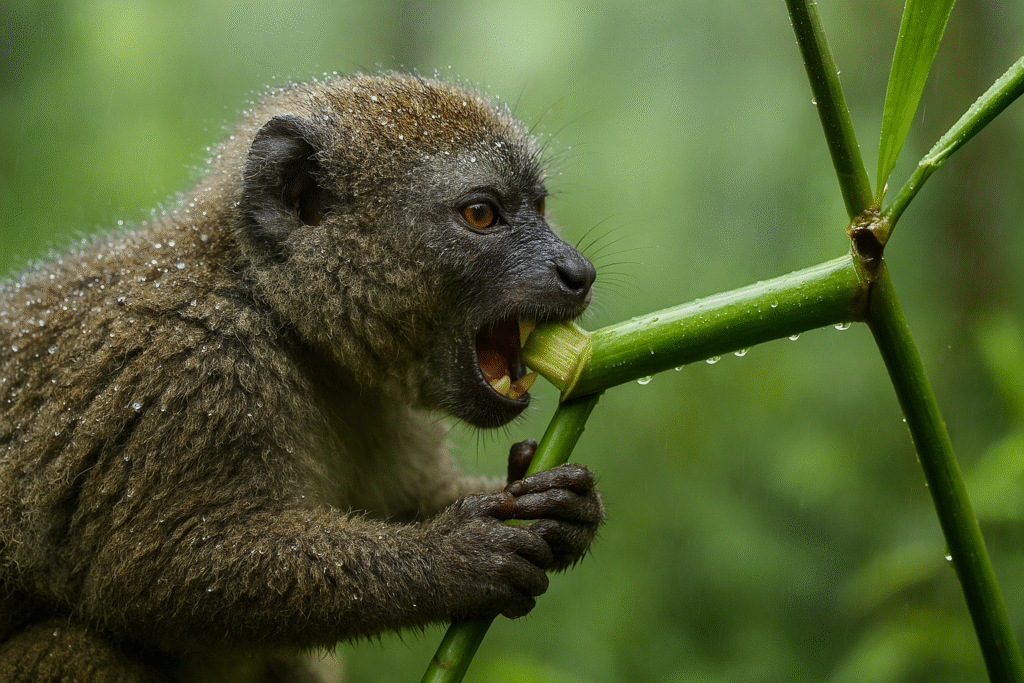
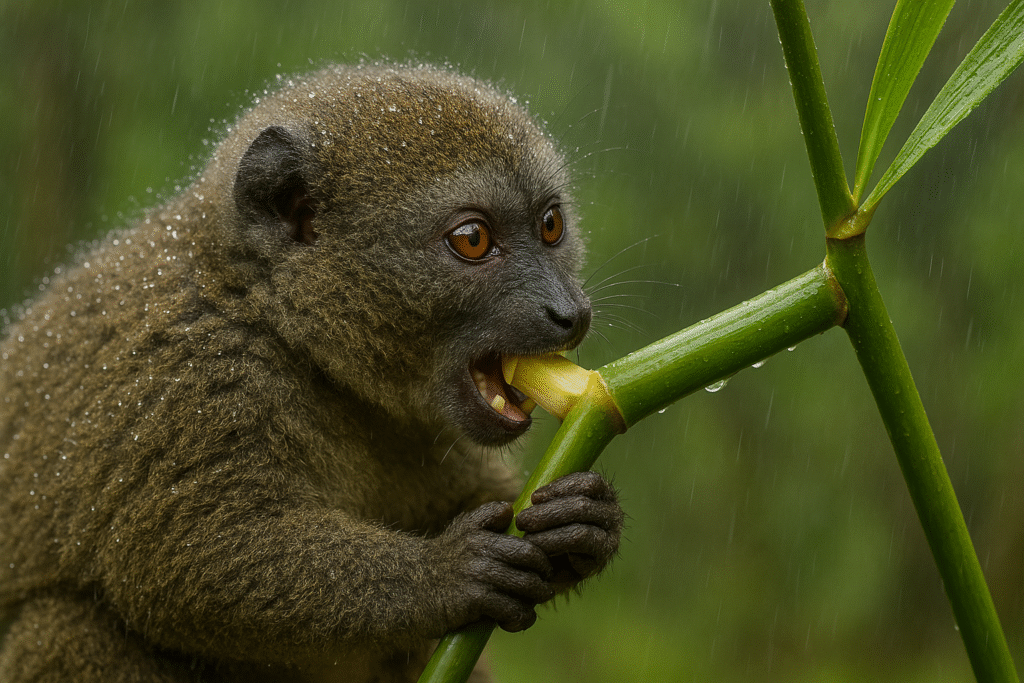
A soft rain stitched lines through the canopy while a small troop fanned across a bamboo thicket. Stalks creaked; leaves made a hush like paper turned slowly. A heavy-headed lemur braced with both hands, angled the culm, and bit clean through a shoot the width of a thumb. Sap ran cloudy. It chewed with patient force, eyes half-closed, jaws working like a carpenter’s vise. On most continents this would be an ordinary snack. In Madagascar, it is survival alchemy: the Greater Bamboo Lemur calmly eating a plant loaded with cyanide.h
Identity: who this lemur is (and isn’t)
- Name & status: Greater bamboo lemur, Prolemur simus (formerly “broad-nosed gentle lemur”). Critically Endangered.
- Look: Stocky for a lemur; broad muzzle, powerful jaw muscles, long tail for balance. Dense gray-brown coat with paler underparts; face framed by soft ruffs.
- Size: The largest of the bamboo lemurs (adult 2.2–2.6 kg; tail often longer than body).
- Range: Fragmented southeastern Madagascar—humid evergreen forests and riverine bamboo belts; strongholds include Ranomafana–Andringitra–Kianjavato forest mosaics.
- Social life: Groups typically 5–12 with multiple adults of both sexes; stable core areas linked by feeding paths through bamboo galleries.
- Clock: Mostly diurnal, but can be cathemeral (active day and night) in some seasons as bamboo chemistry and temperature shift.
Not a panda parallel, not a generalist lemur—this is a specialist tuned to a single, tricky plant.
Strange/remarkable: the cyanide solution
Bamboo in Madagascar defends itself with cyanogenic compounds (think bitter almond chemistry). The greater bamboo lemur is one of the few mammals that thrives on it.
How do they survive?
- Selective biting: They target young shoots and specific nodes where toxin levels and fiber toughness are manageable.
- Paced feeding: Short “bouts” with rests likely allow detoxification between mouthfuls.
- Microbiome aid: A specialized gut community helps process cellulose + cyanides; the jaw and toothcomb process fibrous tissues into digestible ribbons.
- Seasonal switching: In lean months they add pith, leaf bases, and occasional fruits to balance toxin load and energy.
Result: a food web few competitors can use—and one that collapses if bamboo belts are cut.
Survival battle: greater bamboo lemur vs bamboo life
- Dentistry vs. culms: Massive masseter muscles and robust incisors shear shoots; hands reposition culms like levers.
- Energy math: Bamboo is low-calorie; troops spend long hours feeding quietly, keeping travel distances short to conserve energy.
- Predators: Fossa, raptors, and dogs in edge forests. Defense is vigilance + altitude; groups maintain lookout rotation while others feed.
- Weather: Storms that topple bamboo open light gaps (temporary buffets) but cyclones that level entire belts create famines.
What you didn’t know about the greater bamboo lemur (and won’t forget)
- Bamboo connoisseurs. They recognize individual culms and revisit productive plants like bookmarked pages.
- Rain readers. After heavy showers, cyanide concentrations dip; feeding becomes faster, bolder.
- Tool-like hands. Thumb–finger precision lets them peel sheath layers to reach sweet pith without eating excess toxins.
- Quiet talkers. Soft “churs,” contact whistles, and scent posts on bamboo sheaths coordinate movement.
- Seed years matter. When bamboo mast-seeds and dies, lemurs shift patches—corridors decide survival.
- Grandmothers count. Older females know the seasonal map of safe culms; groups with matriarchs feed more efficiently.
- Dental wear = diary. Tooth microwear shows wet vs. dry-season diets—a forensic calendar in enamel.
- Climate squeeze. Upslope movement for cool refuges can outpace bamboo, stranding specialists below.
- Fire shadow. A single grassland fire can bite into riparian bamboo; recovery takes years, not seasons.
- Flagship for water. Bamboo belts stabilize streambanks—saving lemurs also keeps rivers clear for people.
Field guide to the greater bamboo lemur (responsible viewing)
- Where (general): Community-managed forests around Kianjavato; national parks like Ranomafana (with licensed guides).
- When: Early morning after rain—bamboo leaves shine, and feeding peaks.
- How to look: Move slowly, keep voices low, watch mid-canopy bamboo galleries for movement and cleanly cut shoots below.
- Ethics: Stay on paths; no playback, no feeding; keep dogs out; limit group size to reduce edge stress.
Emotional rescue: the culm and the cradle
A juvenile dangled awkwardly from a split culm, one hind leg looped, circulation darkening the foot. The community patrol radioed the research team. A climber in soft gloves reached, steadied the stalk, and clipped the bamboo like a midwife cutting a cord. The youngster clung to the rescuer’s sleeve for a breath and sprang to an adult’s chest. The patrol returned a week later and found the same family—now feeding three meters higher on fresh shoots. No speeches, no ceremony—just a forest choosing life because people showed up on time.
Threats: the modern ledger
- Habitat loss/fragmentation: Slash-and-burn (tavy), charcoal production, small-scale mining, and agricultural expansion shrink bamboo belts.
- Hunting & dogs: Edge forests bring snare risk and dog predation.
- Bamboo collapse: Mast die-offs without corridors; overharvesting of bamboo for stakes and baskets near villages.
- Climate pressure: Cyclones and drought alter bamboo chemistry and growth, stressing a low-flex diet.
- Small, isolated groups: Genetic erosion; a single local disaster can erase decades of gains.
What works (practical, proven)
- Bamboo-first reforestation. Plant native giant bamboos (e.g., Cathariostachys spp.) with mixed forest species; stagger ages for continuous food.
- Corridor stitching. Link riparian belts and hill patches so troops can track post-mast regrowth.
- Community guardians. Pay local patrols to remove snares, cool burns at edges, and protect nursery bamboo from cutting.
- Agroforestry buffers. Provide villagers with fast-growing non-native bamboo outside core habitat to reduce pressure on wild belts.
- Dog control. Vaccination, leashing near forest edges, and no-dog zones on key trails.
- Cyclone planning. Seed banks, bamboo nurseries, and rapid teams to reopen corridors after storms.
- Tourism dividends. Guide jobs, craft markets, and revenue shares tied to lemur presence metrics, not just ticket sales.
Symbolism, culture, mythology
In many highland communities, bamboo is bread, roof, flute, and fence—the plant that becomes a house and a song. The greater bamboo lemur turns the same plant into life from poison, a parable locals already understand: skill beats strength; knowledge beats fear. As a mascot, this lemur is perfect—quiet charisma with a lesson attached.
Majestic photography + storytelling (pro tips)
- Angles: Shoot along a bamboo tunnel to frame the lemur with repeating lines.
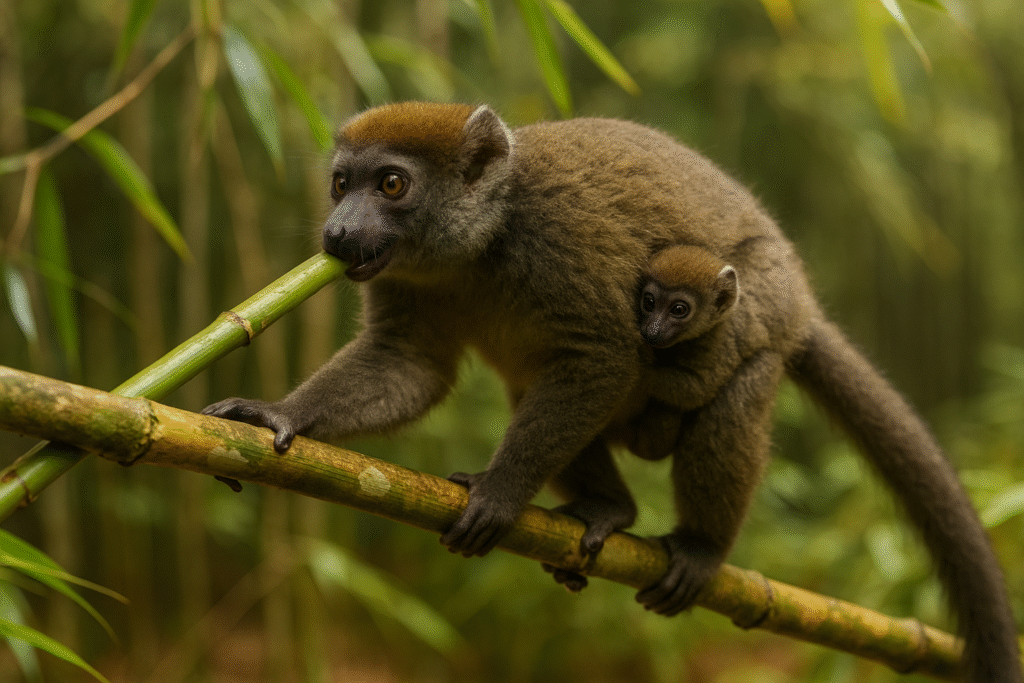
- Moments: Bite-through of a shoot; sheath peeling; adult carrying an infant across culms; rain beading on fur.
- Light: Cloudy days are gold—no harsh contrast under bamboo.
- Caption ideas: “Lemur selecting low-toxin shoot node,” “Matriarch checking a rain-softened culm,” “Family crossing a bamboo bridge.”
Personal narrative + moral
We tracked the troop by the sound of leaves unzipping. At a stream crossing, the matriarch paused on a swaying bridge of green and glanced back—the kind of look that erases time between species. Then she bit, clean as a scissor, and moved on. The forest didn’t roar; it persisted. The moral is simple: keep the bamboo and the knowledge. Stitch patches, plant corridors, pay guardians. Do that, and a primate that eats cyanide for breakfast will keep teaching us how resilience actually looks—quiet, deliberate, green.
Fast FAQ
Why “greater”? Are there others?
Yes—Madagascar has several bamboo lemurs. The “greater” species is the largest and most specialized.
Do they really eat cyanide?
Yes—cyanogenic bamboo. They manage risk via selective feeding, pacing, and gut microbes.
Where can I see them?
With licensed guides in places like Ranomafana or community forests around Kianjavato. Expect careful, low-impact walks.
Are they aggressive?
No. They are shy and focused on feeding. Keep distance and they ignore you.
How can I help?
Support bamboo corridor projects, community patrol wages, and cyclone-response nurseries; when visiting, choose operators who fund local guardians.
Closing
Some mammals impress with speed or size. The Greater Bamboo Lemur impresses with precision—the right bite on the right culm at the right hour after rain. Protect the belts and the people who tend them, and Madagascar keeps a genius on the payroll of the forest.
First, the greater bamboo lemur is a unique primate that eats cyanide-loaded bamboo.
Next, it has special adaptations to detoxify the cyanide.
Then, we must support conservation efforts for this endangered species.
Moreover, supporting community-managed forests helps lemurs and people.iFirst, act now. Second, share knowledge. Third, support conservation. Fourth, help communities. Fifth, spread awareness. Sixth, donate if possible. Seventh, volunteer locally. Eighth, advocate for sustainable practices. Ninth, cherish biodiversity. Tenth, hope for the greater bamboo lemur.
Next, go see. Then, care more. Also, speak up. Afterwards, share facts. Moreover, love nature. Furthermore, act again. Besides, help again. Subsequently, support again. Finally, never give up on the greater bamboo lemur.
Action plan for the greater bamboo lemur
First, act now.
Second, share knowledge.
Third, support conservation.
Fourth, help communities.
Fifth, spread awareness.
Sixth, donate if possible.
Seventh, volunteer locally.
Eighth, advocate for sustainable practices.
Ninth, cherish biodiversity.
Tenth, hope for the greater bamboo lemur.
Then, go again.
Next, see again.
Also, care again.
Afterwards, speak up again.
Moreover, share facts again.
Furthermore, love nature again.
Besides, act again.
Additionally, help again.
Subsequently, support again.
Ultimately, never give up on the greater bamboo lemur.
Additionally, act. Furthermore, help. Moreover, care. Also, speak. Next, share. Then, love. Meanwhile, act again. Afterwards, help again. Besides, care again. Consequently, speak again. Furthermore, share again. Additionally, love again. Moreover, act again. Then, help again. Next, care again. Also, speak again. Afterwards, share again. Meanwhile, love again. Consequently, act again. Ultimately, hope.
Additionally, change is possible. Furthermore, communities can adapt. Consequently, species can recover. Meanwhile, global attention grows. Therefore, every action counts. Moreover, act now. Also, share knowledge. Next, support conservation. Then, help communities. Finally, never give up on the greater bamboo lemur.ally, every small action can help protect the greater bamboo lemur.
Reply