
Rare moment — when a river blows a trumpet
Gharial legacy of antiquity on India’s ancient rivers is the focus of this story.Dawn lays pewter light on a sandbar. Twenty meters out, a long, silver-gray shape surfaces: a male gharial. At the tip of his needle snout sits a dark bulb—the ghara, a hollow “pot” of keratin. He draws breath, inflates, and trumpets—a resonant, bubbling call that makes the sand vibrate. Females align along the current like commas in a sentence; juveniles raft across his back. In a landscape older than any fort on its banks, a sound from prehistory writes the morning’s first paragraph.
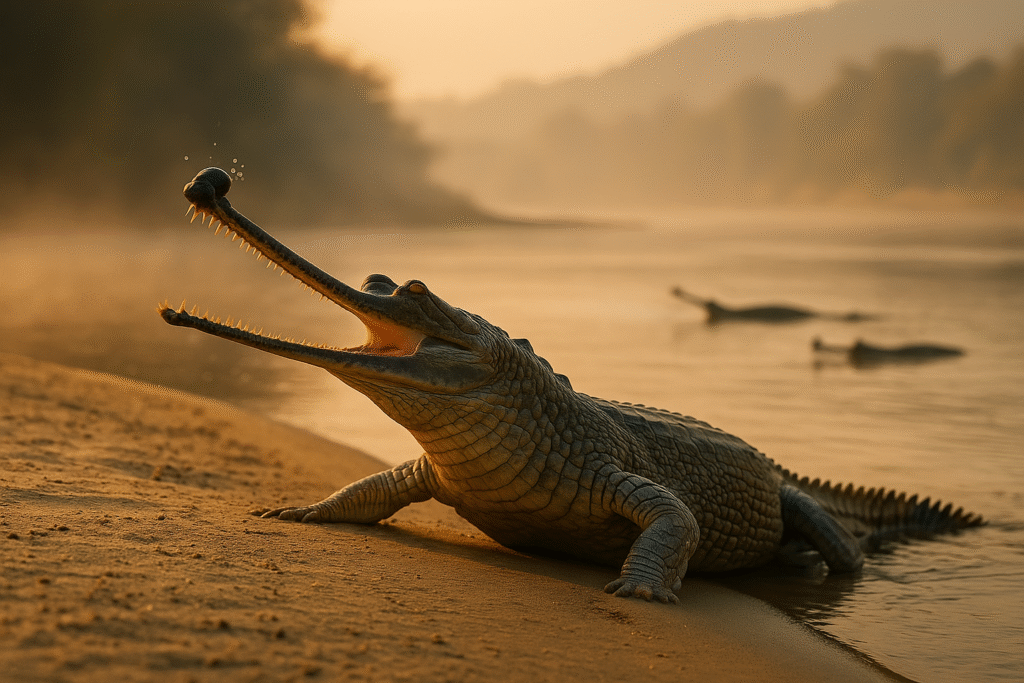
The gharial is not simply a crocodile. It is river architecture in muscle and bone—a specialist from an ancient branch that still holds its original address: the big, warm rivers of the Indian subcontinent.
Identity: what a gharial is (and isn’t)
- Lineage: A distinct crocodilian family (Gavialidae), diverged from crocs and alligators tens of millions of years ago.
- Look: Extremely long, narrow snout lined with interlocking teeth; torpedo body; high, cresting tail for powerful swimming. Adult males grow a ghara at the snout tip—used for sound and display.
- Diet: Almost entirely fish—speed, not siege. Teeth act like a comb; the snout slices water with minimal drag.
- Size: Among the longest crocodilians; big males exceed 5 meters, yet are gracile compared with crocs of similar length.
- Temperament: Shy; rarely aggressive toward people unless handled. On sandbanks, they prefer retreat over confrontation.
- Range (today): Scattered strongholds in India and Nepal (e.g., Chambal, Son, Katerniaghat, Chitwan). Historically ranged across the Indus–Ganges–Brahmaputra systems into Pakistan, Bangladesh, Myanmar.
The gharial is not a man-eater that lurks by ghats; it is a fish specialist designed for current, not conflict.
Majestic photography + storytelling: writing with water and sand
- Where to frame: Low, braided reaches with broad sandbanks; winter mornings for basking lines, pre-monsoon evenings for surface sociality.
- Key behaviors: Male trumpeting with inflated ghara; courtship circling; hatchlings rafting on a parent’s back; synchronized basking with tails curved like calligraphy.
- Ethics: From shore or boat with long glass (≥400 mm). No drones near rookeries. Keep distance from nesting banks; footfalls can collapse egg chambers.
Strange/remarkable: a body that forgot how to be a crocodile—on purpose
- Snout physics: The gharial’s pipelines of bone and air reduce drag; at speed it sculls with the tail while the snout barely ripples the surface.
- Teeth for nets, not armor: Many small, needle teeth are perfect for fish but poor at holding large mammals—specialization over generalism.
- Ghara instruments: Only adult males grow the ghara. It amplifies calls, throws bubbles during display, and visually signals maturity.
- Walking vs. swimming: On land, gharial shuffle awkwardly; in water they transform, capable of astonishing acceleration.
- Nursery fleets: Females and sometimes males guard creches—hundreds of hatchlings moving like living punctuation along the bank.
Survival battle: gharial legacy of antiquity against a net
The gharial’s enemy is not a tiger; it is a monofilament gillnet invisible in brown water. A lunging fish twists, the gharial follows, and the fine teeth snag. Entanglement kills by drowning. Sand mining shaves off nesting banks; altered flows from dams erase incubation cues; riparian grazing and wood cutting open sun-baked nests to trampling. The old route map—deep channels for monsoon, shallows for basking—fractures into unkind geometry.
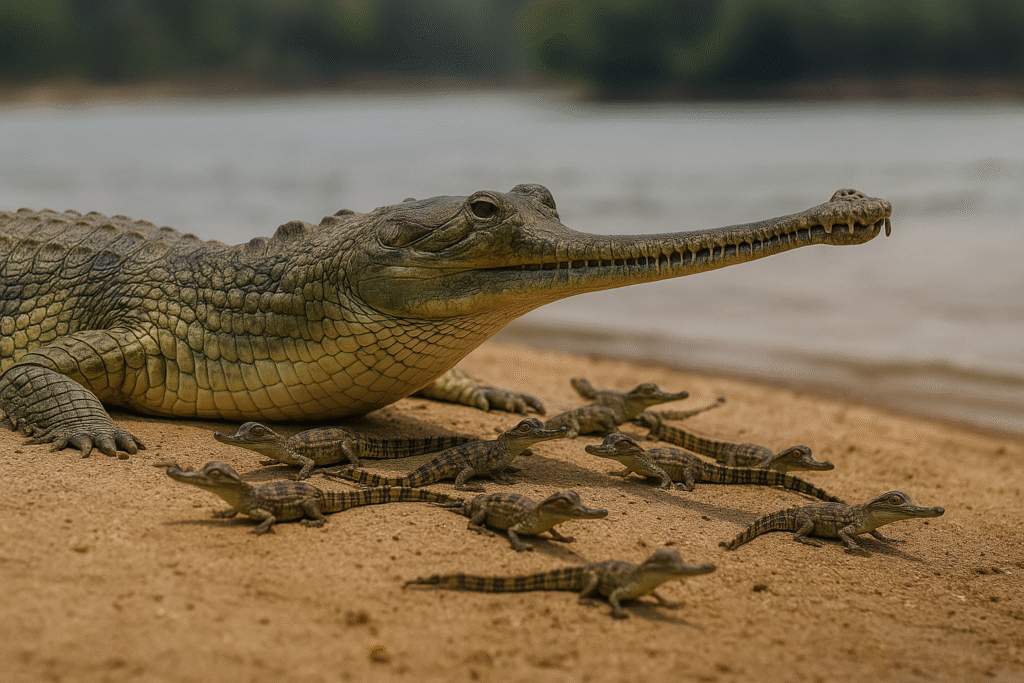
Where rivers are allowed their seasonal widths, gharial remain surprisingly prolific: a single successful nest can launch a hundred hatchlings into the wet world. The problem is making sure the river still has banks to lay on and water to read.
Emotional rescue: the blue tarpaulin and the breathing bag
Villagers flagged a ranger boat: “Nets, there—something moving.” In the rope of translucent line, a subadult gharial thrashed with the losing rhythm that comes before stillness. The team went to quiet code: one person on the tail, one securing the jaws with a soft band, one cutting net away from teeth with curved blunt scissors. They slid a wet cloth over eyes, irrigated the mouth to clear fiber, palpated the ribs, then transferred the animal into a water-filled stretcher bag that supported its belly and let gills stay submerged between breaths. On release, the gharial floated stunned. Ten seconds later it folded, pushed once with the tail, and vanished into the mid-channel green.
Rescues make good headlines. Better are net buy-backs and gear swaps that ensure the next call never happens.
What you didn’t know about the gharial legacy of antiquity (and will remember)
- Fish specialist = narrow skull. The long snout reduces water resistance; broad-snouted crocs would lose speed chasing fish.
- Male “trumpets.” The ghara acts like a resonator; low bubbling calls carry across bends in early morning.
- Hatchlings talk. Babies chirp from inside eggs; adults may unearth them and escort them to water.
- Temperature chooses sex. Nest incubation temperatures set sex ratios; deep sand mining can skew this.
- Freshwater loyalist. Unlike crocs that tolerate brackish water, gharial require fresh, flowing rivers and broad sandbanks.
- Teeth regrow, but… Entanglement can break jaw bones; regrowth can’t fix a bent snout.
- Low land aggression. Their awkward gait and fine teeth make attacks on people exceedingly rare.
- Ancient brand. Medieval and classical art across South Asia depicts makara (river guardian) with a gharial-like snout—myth laid over biology.
- Head-start success. Conservationists collect vulnerable eggs, rear hatchlings, and release them when big enough to outgrow most bird predators.
- Fishers as allies. River guards recruited from fishing families are best at spotting nests and nets—a job shift, not a job loss.
Symbolism, culture, mythology: the river’s heraldic beast
Temple friezes, water spouts, and royal seals across the subcontinent show a long-snouted water creature—the makara, vehicle of Ganga and Varuna. Scholars debate its mix of forms, but along Ganges valleys people still glance at basking gharial and call them nadi ke rakshak—keepers of the river. In the Legacy of Antiquity, the gharial is more than a relic; it is continuity—a living crest that says this water still remembers its work.
Field guide: gharial legacy of antiquity habitats (no pins, just places)
- India: National Chambal Sanctuary, Son, Girwa/Katerniaghat, Ken.
- Nepal: Chitwan, Bardia (reintroduced populations).
- Best season: Winter to early spring—lower water, exposed sandbanks, stable light.
- Signs: Tidy oval nests above flood line; “slide” marks; basking lines with alternating sizes; males with clearly visible gharas.
- Etiquette: Stay off nesting bars Feb–June; use designated ghats; avoid evening net sets in core zones; report snagged animals to rangers.
Threats: the modern ledger
- Fishing nets & longlines (entanglement/drowning).
- Sand mining (erases nesting habitat, destabilizes banks).
- Dams & barrages (alter flow timing, strand hatchlings, block fish migrations).
- Riparian clearing & livestock (trampling nests, collapsing chambers).
- Pollution (pesticides, tannery effluents impacting fish base and hatchling health).
- Small, fragmented populations (genetic drift, vulnerability to bad years).
What works (practical, proven)
- Net-free core reaches with gear swaps (from gillnets to cast nets or fish traps) and buy-back of monofilament.
- Sandbank reserves—seasonal closures around nesting bars; artificial bank building using dredged sand where natural bars vanished.
- Head-start nurseries tied to in-river releases plus long-term monitoring (PIT tags, photo-IDs).
- Environmental flows below dams timed with nesting and hatching windows; fish passages that actually move fish.
- Community ranger programs—stipends for fishers as nest guardians, with revenue from eco-boating and guided riverbird/gharial viewing.
- Forensics + enforcement—net trace tags, spotlight patrols, and quick prosecution of sand mafia activity in sanctuaries.
Climate realism: reading a hotter hydrograph
Hotter summers, flashier monsoons, longer low-flow spells. Gharial management must think in hydrographs: buffer bars with anchored brush to slow scouring, create backwater nurseries for hatchlings during spates, and keep riparian shade to cool microclimates where nests incubate.
Personal narrative + moral
We watched the male lower his ghara until bubbles fled the rim like coins, then he slipped down and became only a ripple headed toward deeper green. I realized how much of a river’s dignity is invisible until a creature like this edits the surface. The lesson is hard to avoid and easy to forget: a healthy river is width + season + sand + fish + people with better options. Remove any one and even an animal shaped perfectly for water will drown in a net you can buy for a few dollars.
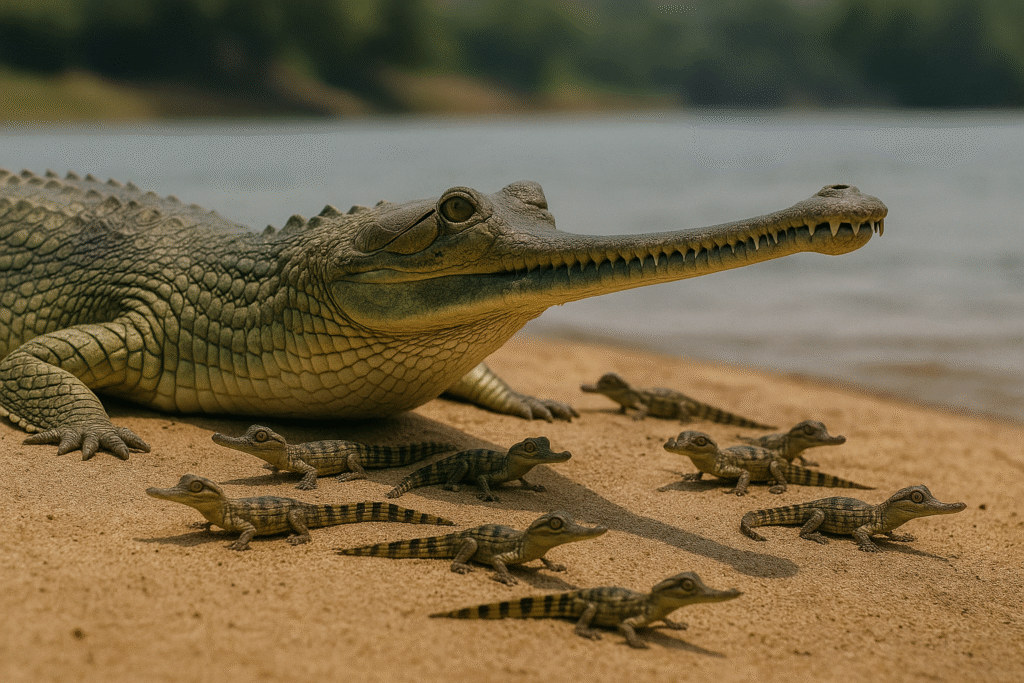
Moral: Buy out the nets, bring back the sand, time the flows, and pay the people who keep watch. Do the ordinary river work well, and an ancient crown keeps sounding over the morning water.
Fast FAQ: gharial legacy of antiquity
Are gharial dangerous to humans?
Generally no. They are shy fish-eaters with fine teeth. Give basking animals space and avoid nesting bars.
Why do males have that bump on the nose?
It’s the ghara—a resonator and visual signal used in mating season to amplify calls and blow bubbles during displays.
Where can I responsibly see them?
Sanctuaries like Chambal (India) and Chitwan (Nepal) with certified guides and designated viewing stretches.
What’s the single biggest threat?
Gillnets. Entanglement kills adults fast. Sand mining and flow alteration erase the next generation.
How can I help from home?
Support groups funding net buy-backs, sandbank protection, and community river guardians; share accurate stories that replace fear with river pride.
Closing
Empires rose and fell along these banks; the gharial remained, reading the same water with the same crown. If we keep the rivers wide, seasonal, and honest, the oldest sentence on the floodplain will continue: a long, bright snout breaking dawn, a trumpet of bubbles, a page of sand signed with tracks.
Action plan for the gharial legacy of antiquity
First, the gharial is a unique crocodilian. Next, we must protect its rivers. Then, communities need support. Moreover, nets must be replaced. Furthermore, education spreads awareness. Finally, act now.

Reply