
Rare moment: the river wrote a cat across it
Amur leopard footprints leave stories in the snow; this article explores them. Dawn took its time in the Primorye hills. Ice fog hung like a curtain between black spruce and leafless oak. We followed a fox line until the valley opened into a shallow river set with blue plates of ice. The snow looked clean until it didn’t: a neat, four-toed track with the asymmetry of purpose. Then another, smaller print stepped perfectly inside the first—a cub learning to place its feet in its mother’s tracks. We stood in the cold seam where Russia folds toward China and watched a female Amur leopard lead her youngster across the frost. She paused once, head high, steam drifting from her nostrils like a small ceremony, and then the pair thinned into birch shadows and were gone.
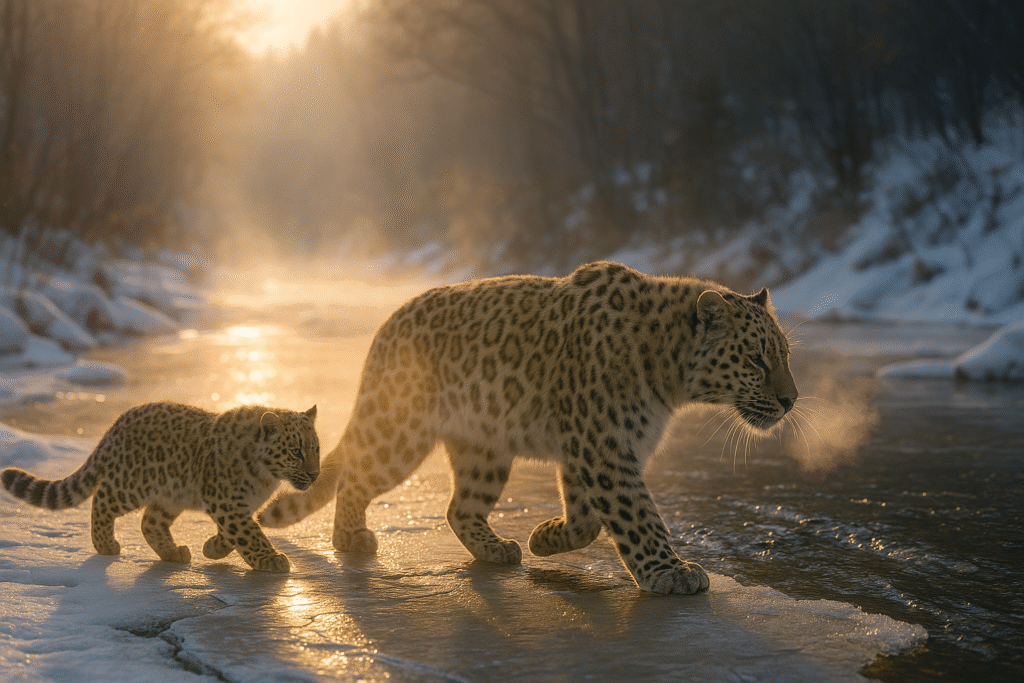
In a lifetime of fieldwork, you get a few seconds like this—the world’s rarest big cat written briefly on white paper, then erased by light.
Identity: who the Amur leopard is (and isn’t)
- Subspecies: Panthera pardus orientalis, the far-northeastern branch of the leopard tree.
- Look: A long-limbed, pale gold cat with huge rosettes rimmed in thick black; winter coat grows lush and long, sometimes draping like a shawl over the shoulders. Tail is heavy and white-tipped for balance in deep snow.
- Size: Lighter than lions or tigers but taller-legged than most leopards—built for snow, rock, and long cold climbs.
- Range: Temperate forests of the Russian Far East and northeastern China—oak–spruce mosaics that burn orange in autumn and steel in January.
- Rarity: Wild numbers are tiny (think low hundreds at best), the result of a century of hunting pressure, habitat loss, and prey collapse.
- Temperament: Methodical, territorial, night-leaning; a specialist in making difficult landscapes profitable.
This is not a tropical leopard shifted north. It is an ice-edge cat—same blueprint, different physics.
Majestic photography + storytelling: how to meet a ghost ethically
- Stage: South-facing slopes where deer browse oak mast; frozen stream crossings at first light; fallen trees that act as scent-marking logs.
- Approach: Low and slow; read wind. If the forest stops sounding (no tits, no nuthatches), back out—you are noise.
- Images that matter: Snow rosettes in low sun; tail curl over ice; mother teaching a cub to step inside her prints; scent-raking on a pine snag.
- Rule: Tracks are a privilege. Photograph them, then brush the trail to protect the cat from two-legged trackers. No drones, no baiting, no playback, no shortcuts through bedding gullies.
Survival battle: hunting at the edge of hunger
Amur leopards live where winter drafts ledgers with red ink. Roe deer browse in islands of sunlight; sika deer skirt oak stands; wild boar root where drifts allow. The cat’s tactic is a topographic ambush—reading micro-contours as if they were sentences: a wind bend here, a hush there, a spruce that turns a shadow into a door. The pounce is not long. It is correct—a short, decisive burst that ends with a throat hold or a suffocating clamp over the nose.
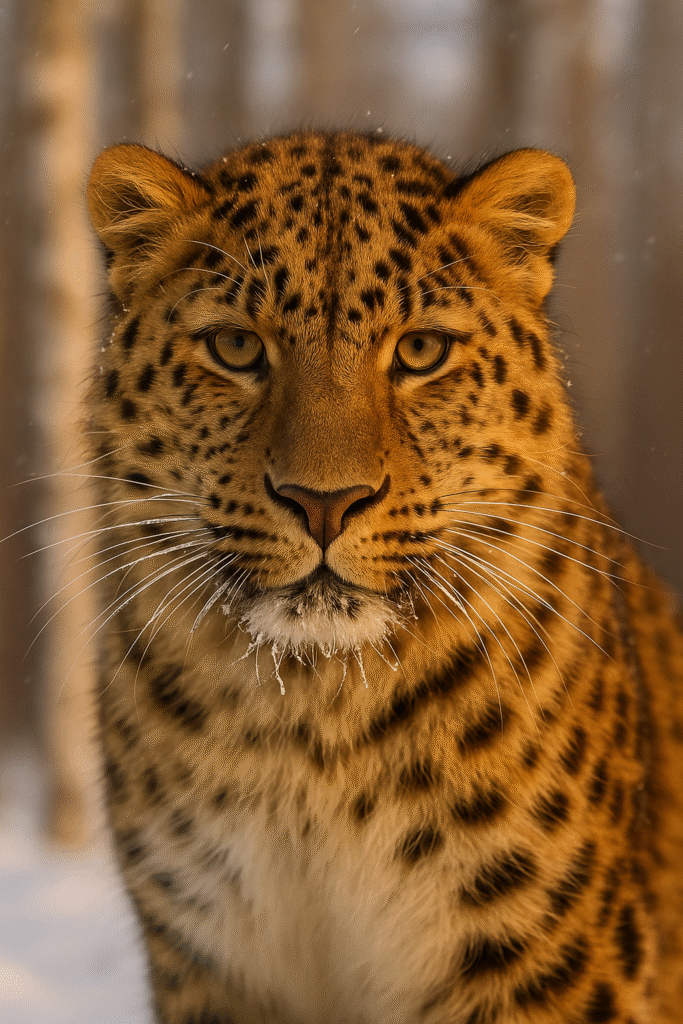
When prey runs thin, risks rise: a boar’s tusk, an icy slide, a broken canine on frozen bone. Energy economics rule everything. The female you watched cross the river will drag a kill to steep shade, cover it with snow and fern, and return for days, feeding the cub first when the balance sheet allows.
Strange/remarkable: Amur leopard footprints — winter engineering written in fur and bone
- Legs like stilts: Longer distal limbs reduce drag in knee-deep snow.
- Fur as physics: Guard hairs in winter are extra-long; dense underfur traps air, insulating without weight.
- Tail as tool: Acts as a counterweight on icy ledges and a scarf for the face in subzero wind.
- Paws as mufflers: Wide, fur-fringed feet mute sound and increase surface area, preventing punch-through in crusts.
- Vision for dusk: Tapetum lucidum tuned for blue-white twilight; rosette contrast breaks the body into shadow fragments among birch and larch.
What you didn’t know about Amur leopard footprints
- They store meals in vertical freezers. Caches are often dragged into rock alcoves where draft keeps meat cold and hidden from scavengers.
- They scent like editors. Claw rakes and urine posts read as marginal notes to neighbors—routes, readiness, rank.
- They out-cat the cold. Documented den sites use south-facing rocks that gather weak winter sun like batteries.
- They cross borders better than maps. Cats ignore passports; camera traps show individuals using both countries as one home range.
- Their worst rival isn’t always a tiger. When prey is scarce, an Amur tiger is a danger; when prey rebounds, leopard–tiger tension loosens and both persist.
- Whisker signatures. Like fingerprints, whisker spot patterns can ID individuals over years.
- Mothers are professors. Cubs practice silent stepping, tree caching, and “wind reading” over a syllabus of months.
- Fire can be a friend—carefully. Low-intensity prescribed burns restore oak and grass mosaics that feed deer, which feed cats.
- Roads rearrange fate. A single highway can pinch a population, turning dispersing males into statistics.
- They are comeback-capable. Where prey, forest, and law align, territories re-fill, and kittens appear on camera like commas in a healed sentence.
Symbolism, culture, mythology
In Far Eastern folklore the forest keeps two masters—the striped king and the spotted trickster. The leopard is the shaper of paths, the one who chooses the narrow way and arrives exactly on time. Hunters speak of it like weather: not seen, only felt—a pause between two bird calls, a fresh scrape on pine, a shifting absence on a ridge. In modern towns the cat has become a flag for temperate forests, a reminder that northern woods can carry charisma equal to coral reefs and savannas.
Field guide: following Amur leopard footprints (without giving away pins)
- Biome: Maritime temperate forests with oak, birch, larch, and Korean pine; steep gullies, rock shelves, mosaic burns.
- Season: Late winter into early spring for tracks and daylight movement; autumn for scent-marking surges.
- Signs: Double-register trackways (cub into mother’s print), snow-kicked caches with hair and frost, pine snags with fresh rake marks at shoulder height.
- Etiquette: Book with certified local guides; stay on agreed routes; radio-silence near denning habitat; never share precise locations online.
Emotional rescue: the iron snare and the quiet bolt-cutter
A ranger found it by accident—wire cinched to a root flare, twists scoured shiny. The loop had fur; the snow carried drops of rust-colored ice. The team worked in whisper protocol: approach downwind, cover the cat’s eyes with a canvas hood, immobilize with vet-approved dose, cut the wire with a low-profile bolt-cutter, irrigate the wound, long-acting antibiotic, satellite call to a roadless extraction point. Hours later the cat stirred, raised its head under a pelt of stars, and loped twelve uneven steps before finding its old grace. The rangers followed their own tracks back and pulled snares for miles until their hands shook.
Rescues make headlines; snare sweeps prevent headlines. The hero is the unphotographed mile.
Threats: the modern ledger
- Poaching & snares: Set for deer or boar but claiming anything that steps through.
- Prey collapse: Overhunting and poor fire regimes starve the cat before a poacher ever sees it.
- Roads & rail: Collision risk and fragmented territories; easy access for illegal hunters.
- Timber pressure & small fires: Remove den trees, simplify structure, push deer away.
- Human–wildlife friction: Livestock depredation when natural prey dips creates retaliation loops.
- Genetic bottleneck: Tiny founding population makes inbreeding a standing risk if dispersal corridors fail.
What works (practical, proven)
- Prey-first recovery. Tighter game regulations; community-led deer restocking where appropriate; prescribed burns that reboot oak mast and grass.
- Snares out, always. Paid patrols, wire-buyback programs, and snare detection dogs; prosecutions that stick.
- Cross-border parks with real corridors. Fences lifted at the bottom wire, green bridges over highways, and quiet zones where cats cross.
- Forest with functions. Selective logging that leaves den logs, snags, and understorey; no clearcuts in core ranges.
- Local dividends. Ranger jobs, eco-tracking tours in buffer areas, compensation funds for verified livestock losses.
- Camera-trap science with discretion. Data shared among trusted partners; blur coordinates in public reports.
Climate realism: snow that forgets how to fall
Warmer winters thin crusts and change deer movement; drought summers sharpen fire. The fix is landscape elasticity—more riparian shade, mixed-age forest, fuel breaks that mosaic rather than sterilize. A forest that keeps options keeps cats.
Personal narrative + moral
When the prints turned uphill into oak shade, we stopped. There are lines you do not cross even when your heart asks you to. The cub had learned to step in its mother’s tracks; we had to learn to step out of theirs. The moral is simple enough to carve into a maple: Leave room for excellence you’ll never see.
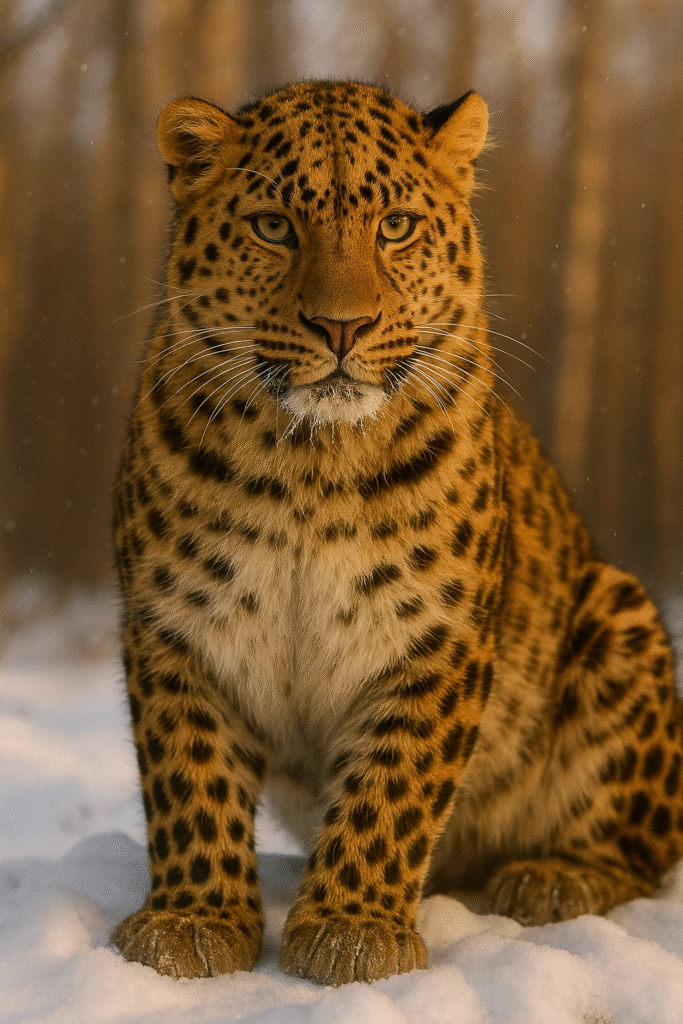
We can make that room with boring decisions done beautifully—fire seasons agreed with science, wire bought and burned, roads bridged, cows paid for when necessary, rangers paid on time always. Do those, and the forest keeps its punctuation marks of fire on snow. Miss them, and winter becomes quieter than it should be.
Fast FAQ: Amur leopard footprints
How rare is the Amur leopard, really?
Wild numbers are very small but increasing where protection, prey, and corridors align. Exact figures vary by survey; treat every individual as priceless.
Do they live with tigers?
Yes—ranges overlap. Tension rises when prey is low; with healthy deer and boar, both big cats coexist in the same landscape.
Are they dangerous to people?
They avoid humans. Most “encounters” are footprints, camera-trap photos, or a tawny blur leaving the scene.
How can I help from home?
Support groups that fund snare removal, prey recovery, and corridor construction; share accurate stories that make temperate forests feel as urgent as tropical ones.
Closing
Some animals shout their existence. The Amur leopard whispers—in frost, in shade, in the moment a cub sets its foot inside its mother’s print and both disappear between birches. Our job is not to make the whisper louder. It is to ensure there is always a forest quiet enough to hear it.
Action plan for Amur leopard footprints
First, the Amur leopard footprints teach us to look more closely at the snow. Next, we must protect its forests and prey. Then, communities need support to coexist with big cats. Moreover, snares and traps must be removed. Furthermore, education spreads awareness. Finally, act now.
Additionally, go. Furthermore, see. Moreover, help. Next, save. Also, act. Then, care. Meanwhile, speak. Afterwards, share. Subsequently, love. Finally, hope.
First, go. Second, see. Third, help. Fourth, save. Fifth, act. Sixth, care. Seventh, speak. Eighth, share. Ninth, love. Tenth, hope.
Reply